
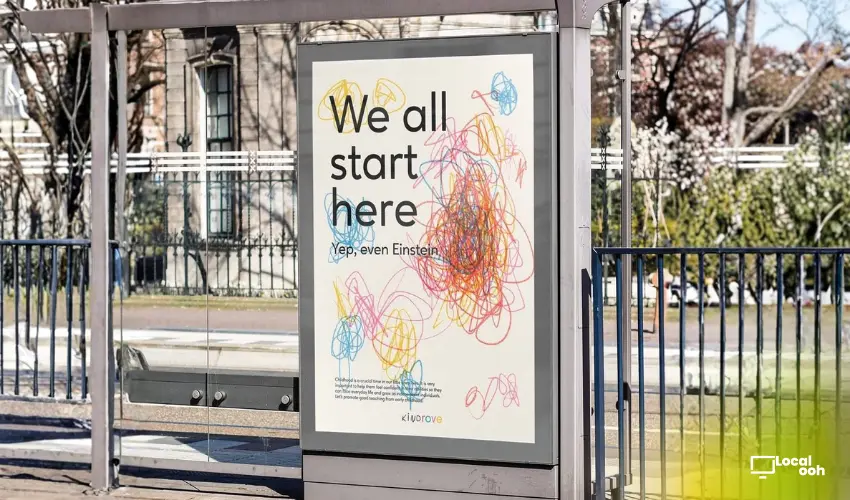
Quick answer: Daycare, childcare, and preschool centers should use local OOH when they need more enrollment inquiries, tour requests, or neighborhood trust. The best campaigns run on parent commute routes and family shopping corridors, use one simple enrollment message, and send parents to a trackable tour or inquiry page. Measure calls, tour requests, branded search, open-house registrations, waitlist growth, and enrolled families.
Why childcare is a strong fit for local OOH
Childcare decisions are local, emotional, and time-sensitive. Parents need a center that feels safe, close, reliable, and easy to visit. They may search online, ask other parents, read reviews, and compare tuition, but recognition still matters.
A billboard or transit placement can make a daycare center familiar before a parent actively searches. When that parent later needs infant care, preschool, after-school care, or summer programming, the center name is already in memory.
Semrush keyword data also supports the category as a real marketing search topic: terms such as childcare marketing, daycare marketing, daycare advertisement, and childcare advertising show measurable U.S. search demand. That means operators are already looking for ways to fill classrooms and improve enrollment pipelines.
Best OOH use cases for daycare and childcare
| Enrollment goal | OOH approach | What to measure |
|---|---|---|
| Fill infant or toddler rooms | Run near parent commute routes and residential corridors | Tour requests, calls, age-group inquiries, waitlist movement |
| Promote preschool enrollment | Use simple trust messaging near family shopping and school routes | Open-house registrations, form fills, enrollment by classroom |
| Launch a new location | Announce opening date and neighborhood service area | Branded search, map searches, tours, pre-enrollment deposits |
| Support summer camp or seasonal programs | Use digital creative to rotate deadlines, ages, and availability | Registration volume, landing page visits, call tracking |
Where childcare OOH should run
The best media plan starts with parent behavior. Parents see the same roads during school drop-off, work commutes, grocery trips, pediatric visits, and weekend errands. OOH works when it appears along those repeated routes.
- Residential commuter roads: useful for repeated exposure among nearby parents.
- Grocery and retail corridors: strong for family shopping routines.
- Routes near pediatric offices: relevant for parents already thinking about care and child development.
- Roads near the center: useful when the creative includes a simple location cue.
- Transit corridors: useful in dense neighborhoods where parents commute by bus or rail.
For a market planning example, review how Local OOH organizes billboard advertising in Alameda County. The same trade-area logic applies to childcare: reach families who can realistically tour and enroll.
Creative that parents understand quickly
Childcare creative should be clear and calm. Parents need to know the center exists, where it is, what age group or program it serves, and what to do next.
- Use one enrollment message: enrolling now, infant care, preschool tours, summer camp, or after-school care.
- Make the center name prominent: parents must remember what to search or call.
- Add one trust cue: licensed care, local teachers, curriculum focus, or years serving the community when accurate.
- Use one next step: schedule a tour, call today, join the waitlist, or visit the website.
- Keep imagery simple: one warm visual works better than a busy classroom collage.
Before final artwork, compare the board against Local OOH creative best practices so the headline and call-to-action remain readable from a moving vehicle.
Recommended campaign structure
- Define the enrollment need: infant, toddler, preschool, after-school, summer camp, or full-center awareness.
- Map the parent trade area: residential clusters, commute roads, pediatric offices, grocery routes, and school corridors.
- Select formats: use billboards for route ownership, transit for dense neighborhoods, and digital OOH for seasonal updates.
- Connect to a tour path: send parents to a short landing page with age groups, hours, tour form, and phone number.
- Track weekly: compare calls, tours, waitlist growth, and enrollments before and during the campaign.
Format options include billboard advertising and transit advertising, depending on how parents move through the market.
Budget and measurement notes
For childcare operators, the value of a campaign depends on enrollment economics. A few enrolled families can justify sustained visibility, but the campaign still needs clear tracking.
Use a unique phone number, campaign landing page, tour source field, branded search monitoring, and weekly classroom enrollment reporting. For pricing variables, read Billboard Costs in 2026.
CTA
If your daycare, childcare center, or preschool needs more local enrollment demand, contact Local OOH with your city, center address, age groups, timing, and enrollment goals.
FAQs
Can outdoor advertising help daycare centers increase enrollment?
Yes. It works best when the campaign runs near parent routes and sends families to a clear tour or enrollment path.
What should a daycare billboard say?
Use one enrollment message, the center name, a program or age cue, a location cue, and one next step.
Which OOH formats fit childcare marketing?
Billboards, transit media, street-level placements, and digital billboards can all work depending on the parent trade area.
When should childcare centers run OOH campaigns?
Use OOH before back-to-school planning, summer camp registration, new classroom openings, open houses, and enrollment pushes.
How should daycare OOH performance be measured?
Track calls, tour requests, source fields, branded search, waitlist growth, open-house registrations, and enrollments.









Comments (0)
Join the conversation. Keep it respectful and on-topic.