
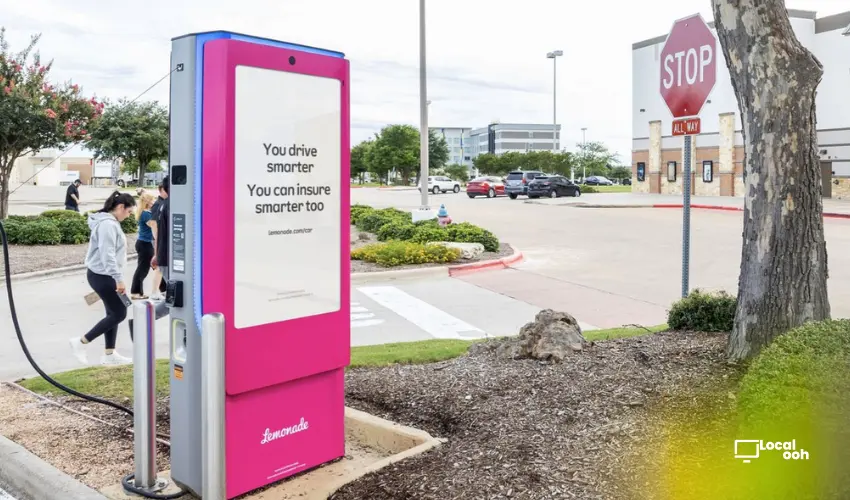
Quick answer: Lemonade partnered with JOLT to transform EV charging stations across Austin with its signature pink branding, offering free charging while reaching electric vehicle owners in an environment directly connected to its car insurance product.
When Context and Creativity Charge Together
Lemonade has demonstrated the value of contextual out-of-home advertising through a citywide activation created in partnership with JOLT.
The campaign transformed EV charging stations across Austin with Lemonade’s recognizable pink branding while offering free charging to local electric vehicle drivers.
Instead of placing a general car insurance message on an unrelated billboard, the brand appeared in an environment where every person using the service was already a vehicle owner.
Free EV Charging Becomes the Brand Experience
The campaign did more than display Lemonade’s visual identity.
By covering the cost of charging, the brand provided a direct and useful benefit to drivers, turning the media placement into a positive service experience.
This gave people a reason to notice, engage with and remember the campaign beyond the advertising message itself.
A Natural Fit for Lemonade Car Insurance
The media environment was closely connected to Lemonade’s car insurance product.
Every charging session reached an electric vehicle owner, reducing the audience waste that can occur when automotive or insurance campaigns appear in broad, untargeted environments.
The activation shows that OOH targeting is not only about audience data. It can also come from selecting a location where the people using the space naturally match the brand’s customer profile.
More Than 90 Minutes of Average Dwell Time
Drivers spent an average of 91.8 minutes charging their vehicles.
That level of dwell time gave Lemonade an extended opportunity to remain visible during a moment when drivers were not simply passing the advertisement at speed.
While not every person would look at the creative throughout the entire charging session, the environment created repeated opportunities for attention and brand recognition.
Why Charging Stations Work as OOH Media
EV charging stations combine utility, location and a clearly defined audience.
Unlike many traditional outdoor formats, they are used directly by the consumers a mobility, automotive or insurance brand may want to reach.
They also create longer waiting periods, making them useful for campaigns that benefit from more than a brief roadside impression.
OOH Supported by Other Marketing Channels
Austinites were informed about the free charging offer through additional marketing activity beyond the charging stations themselves.
This helped drive awareness of the activation before drivers encountered it in person.
The approach demonstrates how OOH can work alongside digital, social and other media channels: those channels explain or promote the offer, while the physical activation delivers the experience.
From Media Placement to Useful Service
The strongest part of the activation is that the media placement and the consumer benefit were closely connected.
Lemonade did not simply advertise near EV chargers. It used the charging experience itself as part of the campaign.
That made the work feel less like a traditional interruption and more like a useful interaction between the brand and the driver.
A Campaign That Beat the Network Baseline
The activation outperformed the previous 14-day baseline across the JOLT network.
This result suggests that the combination of free charging, highly visible branding and wider campaign promotion successfully encouraged stronger engagement with the charging locations.
It also reinforces the commercial value of aligning a relevant incentive with a contextually appropriate audience.
Why This Campaign Works
The campaign works because the product, audience, environment and benefit all support the same idea.
Lemonade wanted to promote its car offering, so it reached verified drivers while they were actively interacting with their vehicles.
By combining contextual placement, free utility, extended dwell time and cross-channel awareness, the activation created an OOH experience that was both relevant and measurable.
What Marketers Can Learn From Lemonade and JOLT
- Contextual OOH can reduce audience waste by appearing in environments directly connected to the product.
- Useful brand experiences can create stronger attention than visual messaging alone.
- EV charging stations offer valuable dwell time and access to a clearly defined audience.
- OOH becomes more effective when other channels build awareness before the physical interaction.
- The strongest media ideas align the location, consumer need and brand proposition.


Comments (0)
Join the conversation. Keep it respectful and on-topic.