
Quick Answer
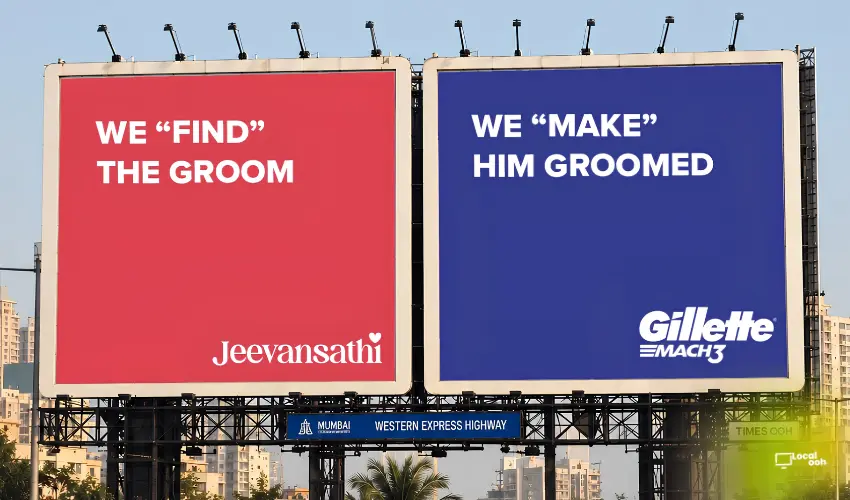
Jeevansathi and Gillette created a connected OOH execution in Mumbai using two consecutive billboards as parts of the same story. Jeevansathi begins with “WE FIND THE GROOM,” while Gillette completes the thought with “WE MAKE HIM GROOMED,” linking partner discovery and grooming through one wedding-focused creative sequence.
Build Connected OOH Stories With Local OOH
Outdoor advertising becomes more powerful when the location of each format is part of the idea itself. Local OOH can help brands plan billboard, digital and multi-format campaigns that work together as one connected story.
From consecutive placements to contextual pairings and high-traffic corridors, the right media plan can turn separate spaces into one memorable creative sequence.
Ready to build a connected OOH campaign? Talk to Local OOH.
Jeevansathi and Gillette Connect Two Billboards Into One Wedding Story
Two brands from completely different categories found a common point in one of the most recognizable stages of a relationship: preparing for a wedding.
Jeevansathi and Gillette brought their messages together in an out-of-home advertising execution that uses two consecutive billboards as if they were parts of the same creative piece.
The activation appears to have been installed along the Western Express Highway in Mumbai, where the audience first encounters Jeevansathi’s role in finding a partner and then immediately sees Gillette continue the story through male grooming.
The result is a compact narrative that moves from finding the groom to getting him ready for the next step.
An OOH Campaign Built Around Two Consecutive Billboards
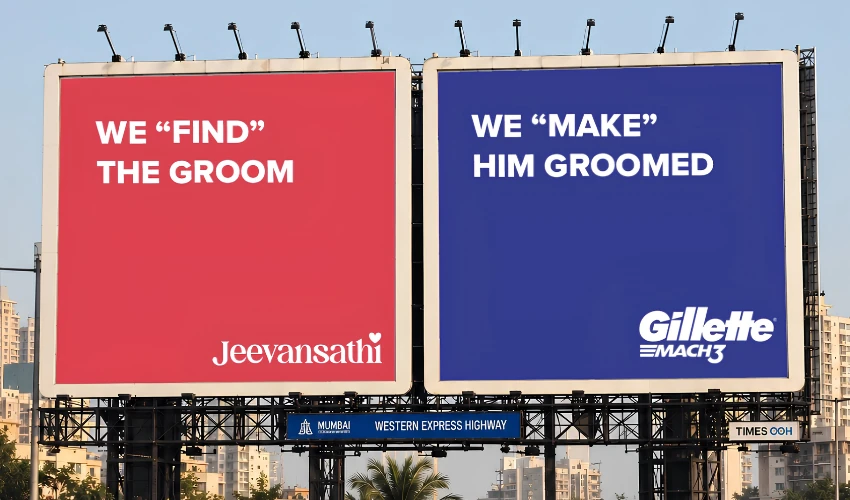
The first billboard belongs to Jeevansathi and carries the line “WE ‘FIND’ THE GROOM”, directly referencing the platform’s role in helping people search for a partner.
Beside it, Gillette completes the idea with “WE ‘MAKE’ HIM GROOMED”, turning the second billboard into the natural continuation of the first.
The creativity depends on the physical order of the placements. Instead of presenting two independent advertisements, the brands build one shared narrative in which each company owns a different stage of the same process.
That makes the media placement itself part of the concept. The campaign would lose much of its effect if the boards were separated or viewed out of sequence.
The Location Is Part of the Creative Mechanism
This type of execution shows why OOH planning can be as important as the copy itself.
The relationship between the two billboards creates the joke, the rhythm and the reveal. The audience understands the first message and then immediately receives the second half of the idea from the neighboring brand.
For collaborative campaigns, this kind of spatial storytelling can help two companies maintain their own identity while still feeling connected through one shared moment.
It also gives audiences a reason to process both pieces together rather than treating them as separate interruptions along the road.
Two Different Brand Roles Inside the Same Story
Jeevansathi is a matrimonial platform designed to connect people looking for a partner. Its proposition focuses on helping users discover matches through criteria such as location, community or profession, supported by verified profiles and relationship success stories.
Gillette, by contrast, enters the campaign through its established territory of men’s grooming. Its portfolio in India includes products such as MACH3, Fusion5, SkinGuard Sensitive and Styler, alongside shaving and grooming content.
Within this campaign, the two brands do not compete for the same consumer role. Instead, they complement one another inside a specific life moment.
Jeevansathi owns the idea of finding the future groom, while Gillette continues the narrative by preparing him for the wedding.
Social Media Extended the Billboard Conversation
The collaboration also moved into social media, where Gillette India supported the shared execution with the line “Found the one. Now let’s make him the one.”
The post encouraged other brands to join the joke, with responses referencing fashion, footwear, food, transport and other categories associated with a wedding.
That extension is important because it shows how a simple roadside idea can become the starting point for a broader brand conversation online.
Instead of treating the billboard as the end of the campaign, the brands used it as a visual prompt that could be repeated, commented on and expanded digitally.
Why the Creative Works
The idea is effective because the connection between the brands is easy to understand without requiring a complicated explanation.
The wordplay between “groom” and “groomed” creates the bridge between Jeevansathi’s matrimonial role and Gillette’s grooming territory.
The campaign also respects the strengths of each brand. Jeevansathi does not need to talk about shaving, and Gillette does not need to talk about matchmaking. Each stays within its own category while the physical media sequence makes the partnership feel natural.
That clarity is particularly useful in OOH, where messages often need to be understood quickly from a moving vehicle or in a short viewing window.
What Brands Can Learn From the Jeevansathi x Gillette Execution
- Use media placement as part of the idea. Consecutive billboards can create a sequence that would not work in isolated placements.
- Find one shared consumer moment. Brands do not need to sell the same product to collaborate effectively.
- Let each brand keep a clear role. The partnership works because each company owns a different stage of the same story.
- Build the copy around fast recognition. The groom/groomed wordplay is simple enough to understand quickly.
- Extend the outdoor idea socially. A strong billboard concept can become a prompt for online conversation and brand participation.
Final Reflection: When Two Billboards Become One Idea
The Jeevansathi and Gillette activation demonstrates how OOH can create value through sequence, proximity and collaboration.
By placing two different brand messages side by side and making each one complete the other, the campaign turns separate media spaces into a single creative story.
For brands exploring partnerships or contextual media strategies, the lesson is straightforward: sometimes the most memorable connection is not created inside one ad, but in the space between two of them.
Summary
The Jeevansathi and Gillette campaign uses the physical relationship between two neighboring billboards to create a single narrative. The first board frames Jeevansathi as the platform that helps find a groom, and the second lets Gillette continue the story through male grooming. By using consecutive placements instead of isolated ads, the brands turn media location into part of the creative idea and connect two very different categories through a recognizable wedding journey.
Sources
Campaign details in this article are based on the information supplied for this post. The precise installation location is described as apparent rather than independently verified.
FAQs
What is the Jeevansathi and Gillette OOH campaign?
It is a connected billboard execution in Mumbai that uses two consecutive placements to tell one wedding-focused story, moving from finding a groom to grooming him.
What do the two billboards say?
Jeevansathi uses “WE ‘FIND’ THE GROOM,” while Gillette follows with “WE ‘MAKE’ HIM GROOMED.”
Where was the campaign placed?
The supplied campaign information indicates that the billboards appear to have been installed along Mumbai’s Western Express Highway.
Why does the campaign work as OOH?
The neighboring placements create one sequential message, making the physical relationship between the billboards part of the creative idea.
How can brands create similar connected billboard campaigns?
Brands can identify a shared consumer moment, assign each partner a clear role and use consecutive placements to build a message in sequence. Local OOH can help plan multi-board and contextual OOH executions.

Comments (0)
Join the conversation. Keep it respectful and on-topic.