
Quick Answer
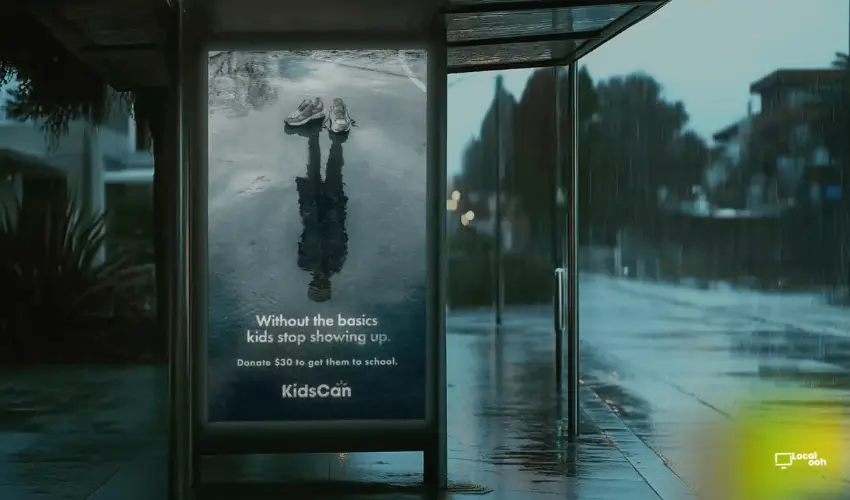
KidsCan’s “Reflections” campaign uses out-of-home, digital and social media across New Zealand to show how poverty can stop children from getting to school. Created by Droga5 ANZ, the work uses worn or unwearable children’s shoes and the reflected silhouette of the missing child to make absence visible and encourage donations of $30 a month to provide essential school items.
Use OOH to Turn Social Issues Into Public Action With Local OOH
When a campaign needs to make an invisible problem visible, outdoor advertising can create public awareness in a direct and emotionally immediate way. Local OOH can help brands and organizations plan billboard, shelter, digital and community-focused campaigns that connect people with meaningful causes.
From awareness-building creative to donation-led calls to action, the right mix of formats can help a simple visual idea resonate in the physical world.
Ready to build a purpose-driven outdoor campaign? Talk to Local OOH.
KidsCan Turns Material Hardship Into a Visible OOH Story
In New Zealand, KidsCan has launched “Reflections”, a new out-of-home, digital and social campaign created by Droga5 ANZ, part of Accenture Song, to show the impact poverty can have on a child’s ability to get to school.
The campaign responds to growing financial pressure on families, with 84% of schools reporting that families are currently under high or extreme financial strain. For some children, going without warm clothing or suitable shoes means more than discomfort. It can prevent them from showing up to school at all.
Rather than approaching the issue with abstract statistics alone, the campaign translates that absence into a powerful visual idea that audiences can recognize instantly.
“Reflections” Uses Absence as the Core Creative Device
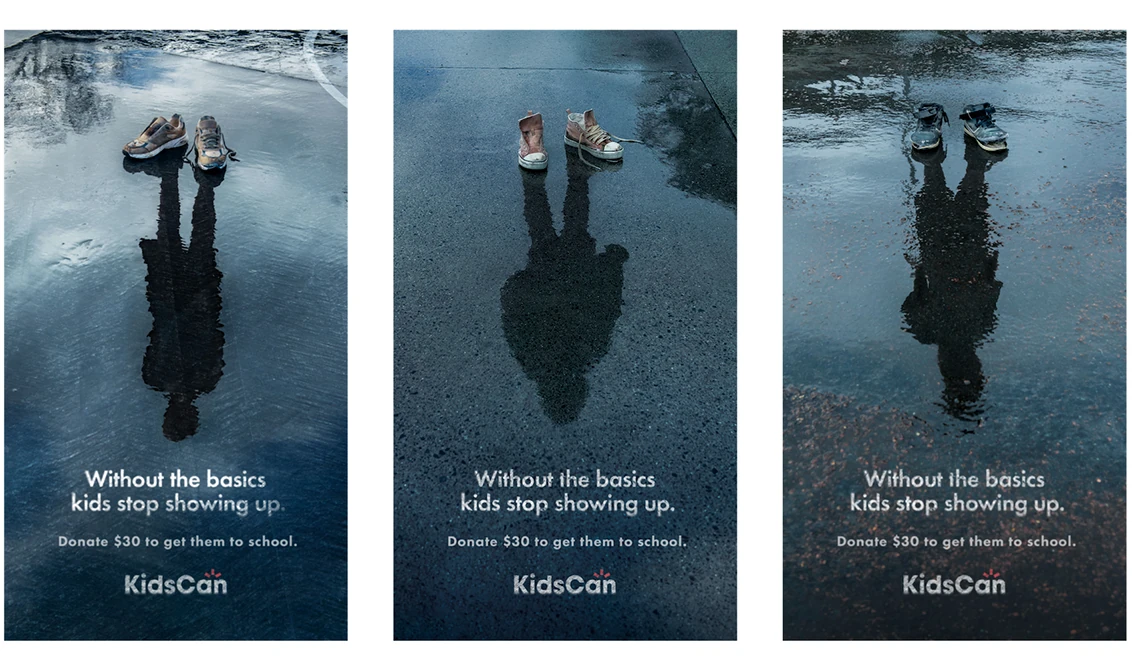
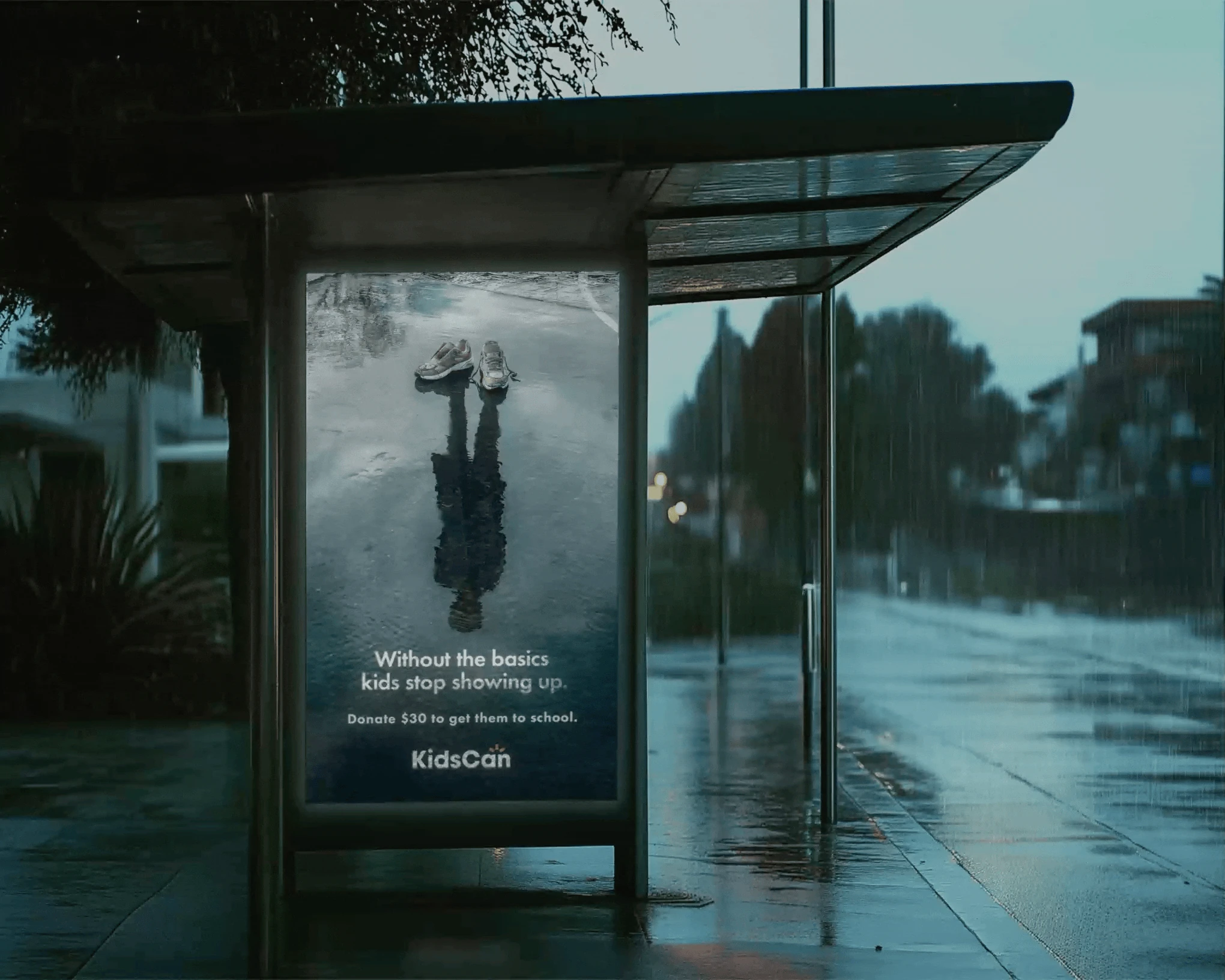
The work centers on unwearable children’s shoes placed against wet pavement, where the reflected silhouette of the child appears below. The child is visible only as a reflection, reinforcing the idea that without the basics, children stop showing up.
This is what makes the campaign so effective. It does not show the child directly in a conventional portrait. Instead, it lets the viewer confront the absence through what should be there, but is not.
The line “Without the basics kids stop showing up” supports the visual with direct clarity, while the call to action asks people to donate $30 to help get children to school.
Footwear Becomes a Symbol of Access to Education
From damaged shoes to shoes without laces, the campaign uses footwear as a simple but loaded symbol of material hardship. These small, everyday objects carry the weight of a much bigger issue: whether a child can participate in school life.
That symbolic choice is especially effective in OOH because it is easy to read quickly. Viewers do not need long explanations to understand that the shoes represent something essential and that the missing child reflected beneath them signals a barrier to education.
According to James Conner and Christie Cooper, executive creative directors at Droga5 ANZ, the idea was deliberately simple: if kids do not have the basics, they stop showing up.
The Campaign Extends Across DOOH, Social and Weather-Triggered Media
“Reflections” runs across digital out-of-home, Lumo Subtle, Meta, social and a weather-triggered dynamic DOOH system, supported by an updated landing page.
That media mix helps the campaign feel responsive to the environments it appears in. The weather-triggered element is particularly fitting because wet ground and reflections are central to the visual idea itself.
By aligning the creative concept with dynamic media behavior, the campaign strengthens the connection between message and setting.
A Clear Donation Ask Keeps the Campaign Actionable
The campaign does more than raise awareness. It gives the public a concrete way to respond by asking them to donate $30 a month to help provide the basics children need to get to school, keep learning and thrive.
That direct ask matters because it closes the gap between emotion and action. A powerful visual can create empathy, but a simple monthly amount helps people understand what the next step looks like.
Julie Chapman, founder and CEO of KidsCan, emphasized that when families cannot afford everyday essentials such as proper shoes, children face real barriers to getting to school and participating fully once they are there.
Why “Reflections” Works in OOH
The campaign works because it is emotionally clear, visually disciplined and easy to process in public space.
It avoids clutter and lets one image do most of the communication. The shoes, the reflection and the line together deliver an immediate emotional logic: when the basics are missing, so is the child.
That simplicity gives the work strong stopping power across both large-format and shelter-based environments. It also helps the idea translate smoothly into digital and social contexts.
What Brands and Nonprofits Can Learn From KidsCan
- Make invisible issues visible. OOH can be especially effective when it translates hidden social problems into physical public images.
- Build around one strong symbol. The shoes act as a focused visual shorthand for a much wider problem.
- Keep the message simple. A short line paired with one memorable image is often enough in public media.
- Match the media to the idea. Weather-triggered DOOH strengthens the reflection concept rather than feeling like a separate tactic.
- Pair awareness with action. A clear donation amount helps convert emotion into response.
Final Reflection: A Campaign That Makes Absence Impossible to Ignore
KidsCan’s “Reflections” campaign shows how out-of-home can deliver both empathy and urgency when it is built around a clear visual truth.
By turning children’s shoes and reflected silhouettes into symbols of educational exclusion, the work makes absence visible in a way that feels immediate, human and difficult to dismiss.
For organizations looking to use OOH for social impact, this campaign offers a strong lesson: the simplest image can sometimes say the most, especially when it invites the public not just to look, but to help.
Summary
Launching across New Zealand through October 11, KidsCan’s “Reflections” campaign responds to growing financial pressure on families, with 84% of schools reporting high or extreme financial strain. The campaign’s visual system focuses on children’s shoes that symbolize material hardship, while reflections in wet ground stand in for the child who is no longer able to show up to school. The work runs across digital out-of-home, Lumo Subtle, Meta, weather-triggered dynamic DOOH, social and a refreshed landing page, pairing a simple emotional idea with a direct call to donate $30 a month.
Sources
Campaign information and visuals were supplied for this article. No independently verified campaign performance data was supplied.
FAQs
What is the KidsCan “Reflections” campaign?
It is a New Zealand campaign by KidsCan and Droga5 ANZ that uses outdoor, digital and social media to show how poverty can stop children from getting to school.
What is the main visual idea behind the campaign?
The campaign shows children’s shoes together with the reflected silhouette of the child who is no longer able to show up to school, making absence visible through a simple image.
Where does the campaign run?
The work runs across digital out-of-home, Lumo Subtle, Meta, social, weather-triggered dynamic DOOH and an updated landing page across New Zealand.
What does KidsCan ask people to do?
The campaign asks people to donate $30 a month to help provide the essentials children need to get to school, learn and thrive.
Why does the campaign work in OOH?
It uses one powerful symbol, a simple message and public formats that make the emotional idea immediate and easy to understand.





Comments (0)
Join the conversation. Keep it respectful and on-topic.