
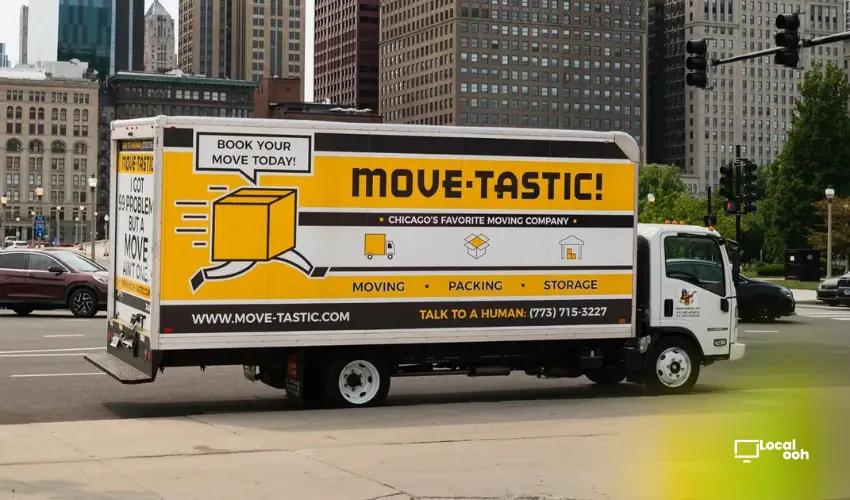
Quick answer: Moving companies should use local OOH when they need more quote requests, local trust, and seasonal booking demand in a defined service area. The best campaigns run near apartments, residential corridors, storage clusters, college routes, military or relocation corridors, and commuter roads. Connect the billboard to a trackable quote page or phone number, then measure calls, moving quotes, booked jobs, branded search, and revenue by move type.
Why movers are a strong fit for local OOH
Moving is a local, high-intent service. People often need help quickly, compare several providers, and look for a company that feels reliable enough to handle their home, apartment, office, or storage move.
Semrush data confirms real marketing demand in the category. Queries such as “moving company marketing,” “digital marketing for moving companies,” “marketing for movers,” and “moving company lead generation” show that movers are actively looking for better ways to generate local demand. Outdoor advertising gives those campaigns a real-world trust layer that search and paid social do not always provide.
A moving company billboard does not need to explain every service. It needs to make the company name familiar before the customer searches “movers near me” or asks for quotes.
Best OOH use cases for moving companies
| Business goal | OOH approach | What to measure |
|---|---|---|
| Generate local moving leads | Billboards near residential corridors, apartments, and commuter roads | Calls, quote forms, booked local moves, branded search |
| Promote apartment moves | Transit and street-level placements near dense rental neighborhoods | Apartment move quotes, landing page visits, call tracking |
| Support peak moving season | Digital OOH with seasonal availability and quote messaging | Quote volume, booking calendar fill, cost per booked move |
| Grow commercial relocation | Media near office districts, industrial corridors, and business routes | Commercial inquiries, consultation calls, revenue by job type |
Where moving company OOH should run
The best locations are tied to move triggers. A mover does not need every driver in the metro. The campaign should reach people near apartment clusters, growing neighborhoods, storage facilities, college housing, office districts, and roads used during relocation decisions.
- Apartment and multifamily corridors: strong for lease turnover and local moves.
- Residential growth areas: useful where new homes, renovations, and family moves are common.
- Storage clusters: relevant because storage and moving needs often overlap.
- Campus routes: useful for student move-in, move-out, and parent-facing messages.
- Office and industrial corridors: useful for commercial moving, warehouse, and business relocation.
For local planning, review how Local OOH organizes billboard advertising in Alameda County. The same trade-area logic applies to movers: buy the routes that influence people who can realistically book your crew.
Creative that works for movers
Moving company creative should be direct and trust-building. People need to know what kind of move you handle, where you operate, and how to request a quote.
- Use one service promise: local movers, apartment moves, packing help, long-distance moves, or office relocation.
- Show the brand clearly: the company name must be easy to remember later.
- Add one trust cue: licensed, insured, local crews, family-owned, or years in market when accurate.
- Use one action: get a quote, call today, book your move, or search the company name.
- Keep the design simple: one headline, one visual, one URL or phone number.
Before production, compare the board against Local OOH creative best practices so the phone number, URL, and headline remain readable in traffic.
Recommended campaign structure
- Pick the move type: local, apartment, long-distance, packing, storage-connected, student, or commercial.
- Map the service area: apartments, residential growth, storage corridors, campuses, and business districts.
- Select formats: use billboards for route authority, transit for dense rental areas, and digital OOH for seasonal copy.
- Create a quote path: use a short landing page with service area, phone number, quote form, and availability cues.
- Track booked jobs: measure not only leads, but booked moves and revenue by job type.
Relevant formats include billboard advertising, transit advertising, and market-level planning in areas such as New York OOH markets.
Budget and measurement notes
Moving companies should judge OOH by quote quality and booked revenue. A cheap board outside the service area can waste budget, while a visible route near apartment turnover or residential growth can support both brand recall and direct response.
Use a unique phone number, a campaign landing page, UTM parameters, source fields in quote forms, branded search monitoring, and booked-move reporting. For pricing variables, read Billboard Costs in 2026.
CTA
If your moving company needs more local quotes, apartment moves, commercial relocations, or seasonal booking demand, contact Local OOH with your service area, move types, timing, and lead goals.
FAQs
Can billboards generate leads for moving companies?
Yes. Billboards can support moving leads when the campaign reaches the right service area and connects to a trackable quote path.
What should a moving company billboard say?
Use one service promise, the company name, a service-area cue, a trust cue, and one action such as get a quote.
Which OOH formats work for movers?
Billboards, transit media, and digital billboards can all work depending on whether the campaign targets local moves, apartment moves, or commercial relocation.
When should movers run OOH campaigns?
Use OOH before summer moving season, lease turnover months, college move periods, military relocation windows, and market launches.
How should moving companies measure OOH?
Track calls, quote forms, branded search, booked jobs, route-level response, and revenue by move type.






Comments (0)
Join the conversation. Keep it respectful and on-topic.