
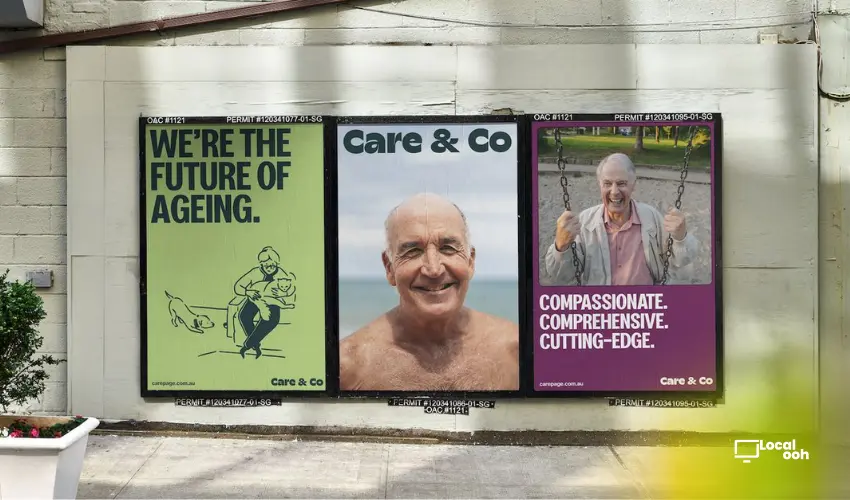
Quick answer: Senior living and assisted living communities should use local OOH when they need to build trust, increase tour requests, and stay familiar to adult children making care decisions for parents. The best campaigns use warm, simple creative on routes near residential neighborhoods, hospitals, medical offices, grocery corridors, and commuter paths. Measure calls, tour requests, branded search, inquiry quality, and move-ins by campaign window.
Why senior living is a local trust decision
Senior living is not an impulse purchase. Families compare care levels, location, reputation, staffing, amenities, and emotional fit. The decision often starts long before a tour is scheduled, and the first search may be influenced by brands the family already recognizes.
Outdoor advertising helps a community become familiar in the physical world. A billboard near the right routes can make a community name feel established before an adult child, spouse, or older adult begins active research.
That matters because the buyer is rarely one person. A senior living decision may include adult children, siblings, a spouse, a physician, and the older adult. OOH creates shared local awareness that digital-only campaigns often miss.
Best OOH use cases for senior living
| Campaign goal | Best OOH role | What to measure |
|---|---|---|
| Increase assisted living tours | Build familiarity in the community trade area | Tour requests, calls, inquiry forms, scheduled visits |
| Promote memory care | Reach adult children with a clear care message | Memory care inquiries, call quality, consultation bookings |
| Launch a new community | Announce local presence before opening or lease-up | Waitlist signups, open house attendance, branded search lift |
| Support seasonal occupancy | Keep the community top-of-mind during decision windows | Move-ins, lead source notes, occupancy by care level |
Where senior living OOH should run
The best locations are usually near the people who influence the decision, not only near the community building. Adult children may live, shop, commute, or work several miles away from the community they eventually tour.
- Residential commuter routes: strong for adult children who pass the message repeatedly.
- Medical corridors: useful near hospitals, specialist clinics, rehabilitation centers, and pharmacies.
- Grocery and retail routes: useful for repeated weekly visibility among local families.
- Highway approaches near the community: useful when the creative can include a simple directional cue.
- Dense urban neighborhoods: transit and street-level formats can help when families are not primarily driving.
For a market planning example, review how Local OOH organizes billboard advertising in Alameda County. The same logic applies to senior living: match the media to the real service area and the family routes that influence care decisions.
Creative that respects the decision
Senior living creative should feel calm, human, and specific. Avoid trying to list every amenity. The person seeing the billboard needs to remember the community and understand the next step.
- Use one care message: assisted living, memory care, independent living, respite care, or schedule a tour.
- Show local trust: mention the city, neighborhood, years in service, or local care team when accurate.
- Make the action simple: schedule a tour, call today, visit the website, or search the community name.
- Keep copy readable: one headline, one support line, and one contact path.
- Use photography carefully: warm, real-feeling imagery is better than crowded lifestyle scenes.
For readability and layout principles, use the Local OOH creative best practices before final artwork is produced.
Recommended campaign structure
- Define the care objective: assisted living, memory care, independent living, respite, or general awareness.
- Map family influence zones: residential areas, medical corridors, shopping routes, and commuter flows.
- Select formats by behavior: use billboards for broad reach, transit for dense neighborhoods, and digital for message rotation.
- Connect to a tour path: send traffic to a clear landing page with phone, tour form, and care-level information.
- Review weekly lead quality: track tours and move-ins, not only form fills.
Format options can include billboard advertising, transit advertising, and local market placements in areas such as New York OOH markets.
Budget and measurement notes
Senior living campaigns should be evaluated by qualified inquiry and move-in economics, not by raw impressions alone. A single move-in can justify sustained visibility, but the campaign still needs disciplined tracking.
Use a unique phone number, campaign landing page, inquiry source field, branded search monitoring, and weekly tour reporting. If the campaign uses multiple boards, track results by market or route where possible.
For pricing variables, see Billboard Costs in 2026.
CTA
If your senior living, assisted living, or memory care community needs more local tour demand, contact Local OOH with your city, community address, care levels, timing, and occupancy goals.
FAQs
Does outdoor advertising work for senior living communities?
Yes. It works best when the message builds local familiarity and sends families to a clear tour or inquiry path.
What should a senior living billboard say?
Use the community name, one care message, one trust cue, and one next step such as schedule a tour or call today.
Which OOH formats fit assisted living marketing?
Billboards, digital billboards, transit media, and street-level placements can all work depending on the service area and family routes.
When should senior living communities run OOH?
Use OOH before open houses, new openings, occupancy pushes, memory care campaigns, and long-term local awareness efforts.
How should senior living campaigns be measured?
Track calls, tour requests, branded search, lead source fields, scheduled visits, and move-ins by campaign period.




Comments (0)
Join the conversation. Keep it respectful and on-topic.