
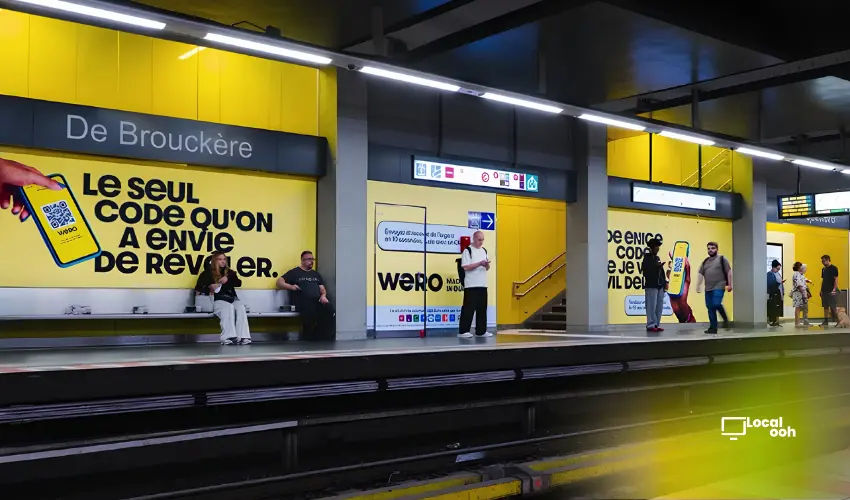
Quick answer: WERO, the payment solution from EPI Company, launched with a three-week takeover of De Brouckère metro station in Brussels, using urban DOOH to create immediate visual impact and connect with active young audiences.
A Payment Brand Built for the Urban Journey
WERO brought its payment solution into the heart of Brussels with a full takeover of De Brouckère metro station.
The campaign ran for three weeks, using the station environment as a high-impact platform to introduce the brand to commuters, students, workers and connected city audiences.
For a payment solution designed around modern daily life, the metro station offered a natural setting where speed, convenience and mobility already matter.
Why De Brouckère Was the Right Location
De Brouckère is one of Brussels’ most recognisable urban transit environments.
The location gave WERO access to an active audience moving through the city as part of their everyday routines.
By appearing in a busy metro station, the campaign placed the brand directly in the daily element of its target audience: young, connected and constantly on the move.
Urban Display Meets Brand Fit
The strength of the activation lies in the fit between the brand identity and the media environment.
WERO’s vibrant visual language worked in harmony with the station’s architecture, creating an immediate sense of visual presence.
Instead of feeling like a standard transit ad, the takeover used the space as part of the brand experience.
Immediate Visual Impact
Station takeovers are powerful because they surround audiences with a consistent message across multiple surfaces.
For WERO, that meant creating a bold and cohesive visual system that could be noticed quickly in a busy urban setting.
The result was a campaign designed not only to be seen, but to feel embedded in the rhythm and architecture of the station.
Precision Targeting in a Daily Environment
The campaign was built around precision targeting.
Rather than speaking to a broad audience in a generic media context, WERO appeared in a place where its target users are already moving, meeting, commuting and using digital services.
This made the metro station a relevant environment for introducing a payment solution connected to everyday urban behaviour.
Why DOOH Works for Fintech Launches
Fintech brands often need to build trust, recognition and familiarity quickly.
Digital out-of-home helps by giving a new payment solution visible presence in public environments where people make daily decisions and interact with the city.
For WERO, the takeover helped transform a digital product into a physical brand experience that people could encounter repeatedly over three weeks.
From Awareness to Everyday Relevance
A payment solution becomes more meaningful when it is connected to real-life movement.
By launching in a metro station, WERO positioned itself within a context of transit, convenience and urban activity.
That relevance helps the campaign move beyond awareness, making the brand feel connected to the way people already live and move through Brussels.
Why This Campaign Works
The campaign works because the location, audience and brand promise are aligned.
WERO needed to launch a modern payment solution, and De Brouckère offered a dynamic urban environment where the message could feel useful, visible and culturally relevant.
By combining a three-week takeover, strong visual identity and precise transit targeting, the campaign shows how DOOH can capture attention exactly where it matters.
What Marketers Can Learn From WERO
- Station takeovers are strongest when the brand identity works naturally with the architecture.
- Fintech campaigns can benefit from appearing in environments linked to mobility and daily convenience.
- Urban DOOH helps digital products feel tangible, trusted and present in the real world.
- Precision targeting is more effective when the media location reflects the audience’s lifestyle.
- A strong environmental fit can turn a transit placement into a memorable brand experience.

Comments (0)
Join the conversation. Keep it respectful and on-topic.