
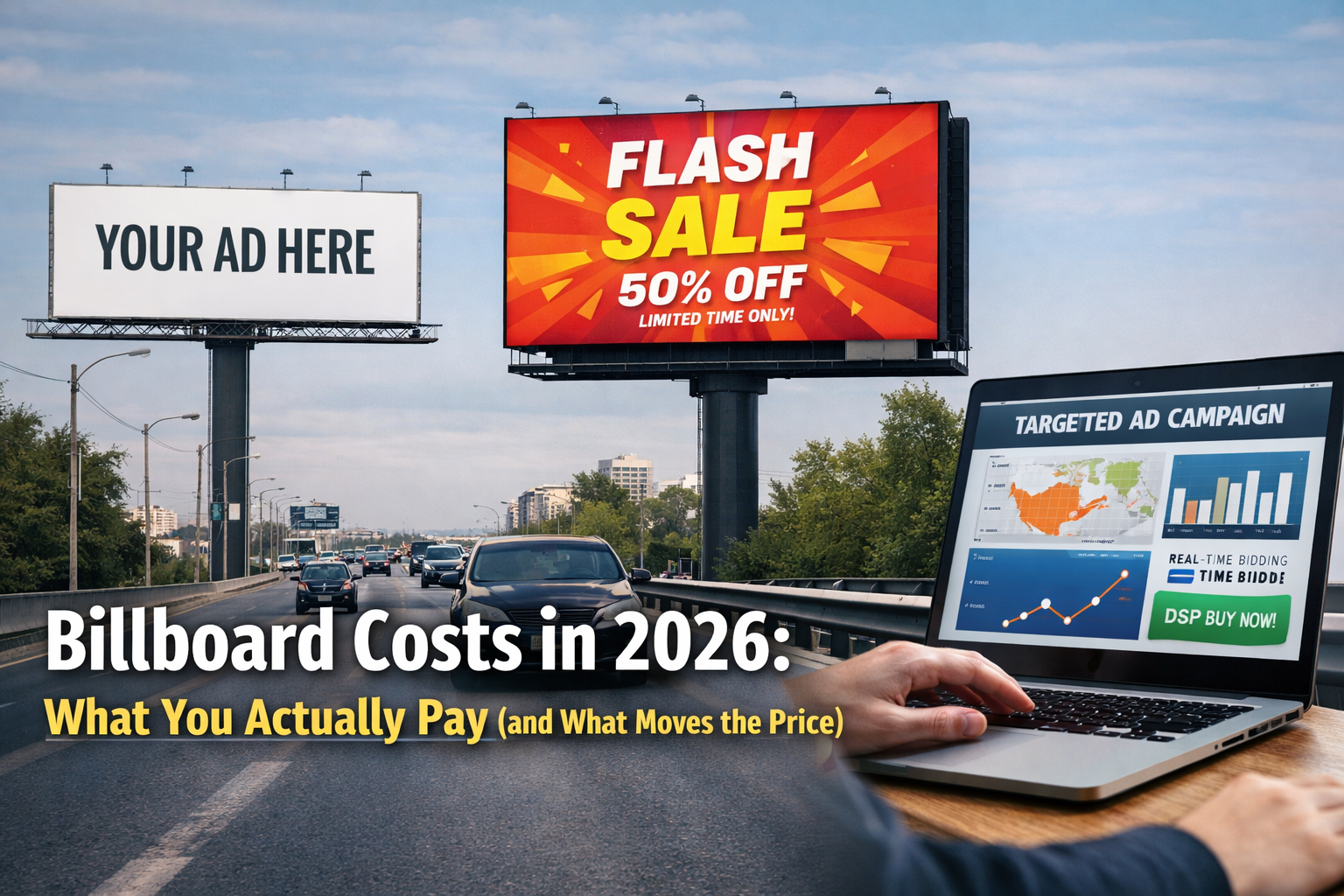
Quick Answer: Billboard pricing isn’t a single number. It’s a stack of variables: location, speed environment, format, share-of-voice, availability, and campaign length. Here’s how pricing actually works for static, digital, and programmatic DOOH in 2026.
If you’ve ever asked, “What does a billboard cost?” and received ten different answers—welcome to OOH.
The reality is simple: billboards don’t have menu pricing. Their cost is shaped by where they live, how they run, and how scarce the inventory is.
Static vs digital vs programmatic: what actually changes
Static billboards
- You pay for a fixed face for a fixed period (typically 4-week posting cycles)
- Pricing is driven heavily by location, visibility, and long-term availability
- Best suited for memory building, consistency, and sustained presence
Digital billboards
- You pay for a share of the loop, not exclusive ownership
- Impressions are shared across advertisers
- Pricing increases in premium corridors and during peak dayparts
Programmatic DOOH
- Allows buying shorter time windows and specific targeting rules
- Pricing fluctuates based on supply, demand, and filters
- Offers flexibility, but less permanence than fixed buys
The 10 biggest factors that move billboard pricing
- Market size & demand
New York ≠ mid-market pricing - Visibility & angle
Readability almost always beats size - Speed environment
Highway, arterial, street-level, or transit - Proximity to landmarks
Airports, stadiums, downtown cores - Share-of-voice
How much of the loop or rotation you control - Dayparting
Peak hours cost more - Seasonality
Holidays, major events, back-to-school periods - Campaign length
Longer commitments often improve efficiency - Creative complexity
Dynamic versions and multiple assets add cost - Production & installation
Printing, finishing, or digital trafficking
What else you may pay for (and why it’s normal)
Beyond media space, OOH campaigns often include additional line items:
- Production — printing, finishing, and sometimes installation
- Creative resizing — adapting artwork across multiple specs
- Venue approvals — copy or design reviews required by certain locations
- Rush fees — when turnaround timelines are compressed
These costs aren’t hidden fees—they’re part of how physical media operates.
How to get better value without buying “cheap”
Lower cost doesn’t always mean better value. Smarter planning does.
- Prioritize corridors with repeat commute traffic
- Focus on clarity—better creative often outperforms bigger spend
- Negotiate packages across multiple units or longer terms
- Match the buy to the objective—don’t place a premium spectacular behind a niche local offer
FAQs
Is OOH cheaper than digital?
It’s a different cost logic. OOH buys physical presence and repeated real-world exposure, not clicks or impressions alone.
Why are OOH contracts often sold in 4-week cycles?
OOH inventory is commonly traded in standardized posting periods, which simplifies scheduling, billing, and inventory management.
What’s the fastest way to reduce billboard cost?
Reduce premium corridors, lower share-of-voice, or shift to programmatic or time-window-based buying.
Bottom line
Billboard pricing in 2026 isn’t opaque—it’s contextual.
When you understand the variables, you stop asking “Is this expensive?” and start asking “Is this the right spend for the objective?”


Comments (0)
Join the conversation. Keep it respectful and on-topic.