
Quick Answer
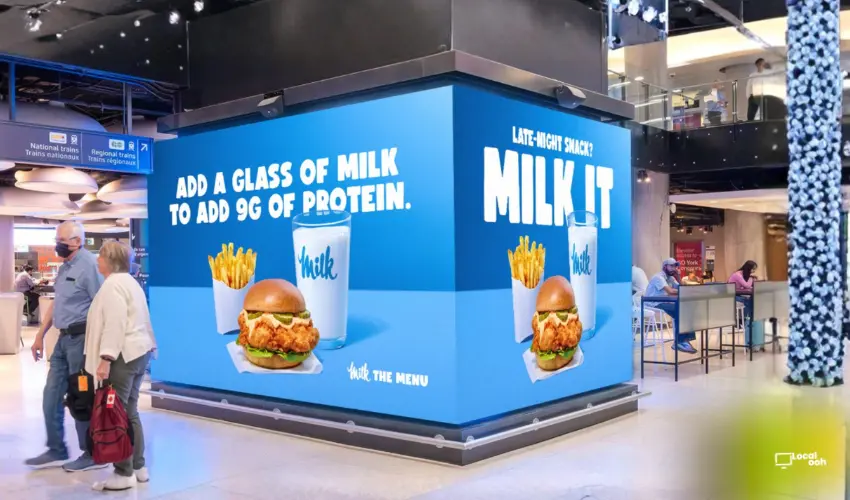
“Milk the Menu” brings milk into everyday meal decisions through contextual media, including a major Union Station takeover. The campaign encourages people to add a glass of milk to meals for 9g of protein, using dayparted DOOH, social creators, Pinterest and digital video to connect the message with different eating occasions throughout the day.
Start Your Campaign With Local OOH
If your brand wants to connect advertising with the places and moments where customers are making real decisions, Local OOH can help bring your next campaign into the physical world .
From DOOH, transit advertising and street furniture to billboards and contextual placements near retail and dining environments, the right location can make the message more relevant to the audience.
Ready to start your campaign? Talk to Local OOH .
“Milk the Menu” Meets Consumers at the Moment of Choice
The campaign is built around a simple idea: reach people when they are already deciding what to eat and show how easily a glass of milk can become part of that meal.
Rather than treating protein as a separate nutritional message, “Milk the Menu” connects it directly with familiar eating occasions.
The message is straightforward: add a glass of milk to a meal to add 9g of protein.
That simplicity makes the idea particularly well suited to out-of-home and DOOH advertising, where audiences often have only a few seconds to understand the creative.
Union Station Turns the Message Into Part of the Commute
A major part of the campaign is a takeover at Union Station, where the message becomes part of commuters' daily routines.
The location allows the campaign to appear while people are already moving through the city, traveling, thinking about food or looking for something to eat.
That makes the media environment highly relevant to the message.
Instead of placing nutrition advertising in an unrelated location, the campaign uses contextual DOOH to connect milk with real meal decisions.
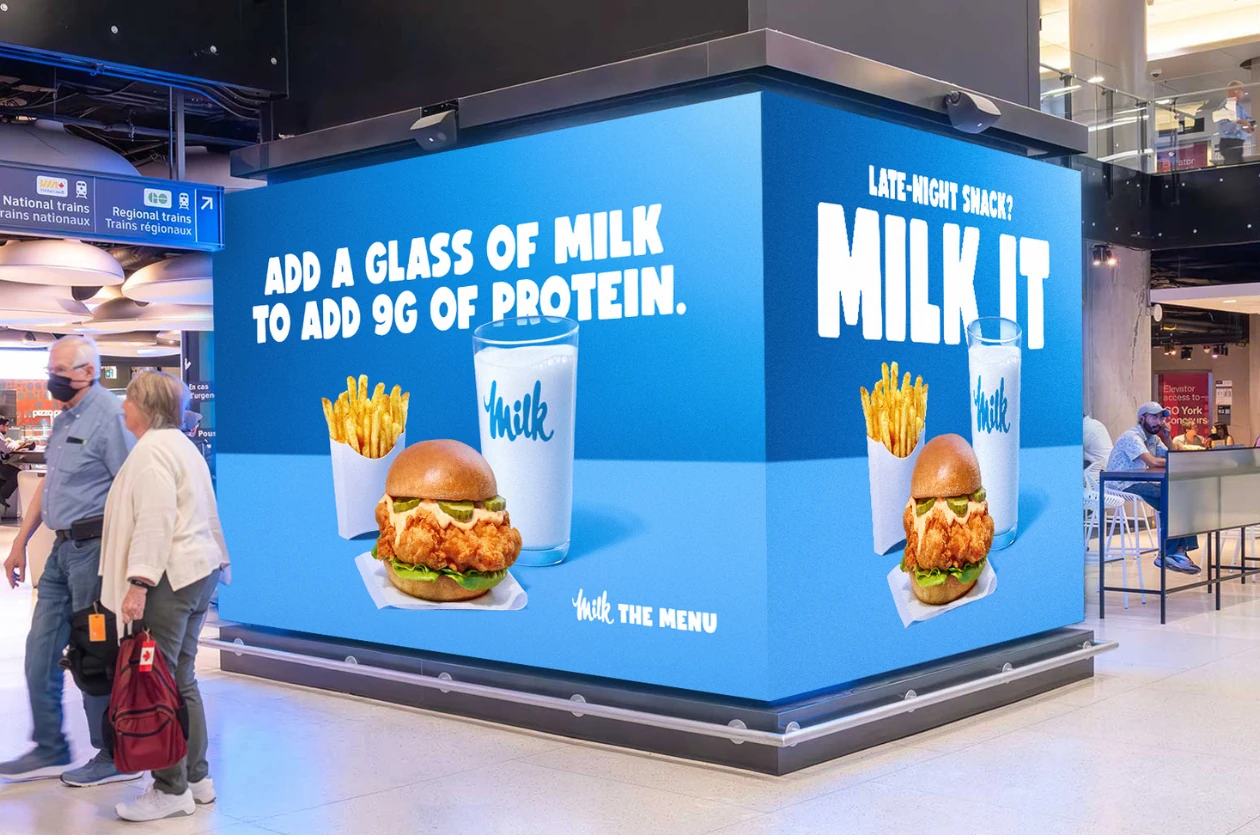
The supplied creative demonstrates how quickly the idea can be communicated.
A chicken sandwich, fries and a glass of milk are shown together with the message: “Add a glass of milk to add 9g of protein.”
Another side of the display reinforces the campaign platform with: “Late-night snack? Milk it.”
The food imagery does much of the work. Audiences do not need to imagine an abstract nutrition scenario because the campaign places milk directly alongside an everyday meal.
A Simple Behavior Instead of a Complicated Nutrition Message
One of the strengths of “Milk the Menu” is that it does not ask audiences to learn a complicated new routine.
The campaign takes something people already do — eat meals they enjoy — and adds one simple action.
That idea is reflected in the line: “Whatever’s on the menu, milk it.”
The creative therefore makes protein part of an existing routine rather than presenting it as a separate lifestyle commitment.
Social Creators Extend “Milk the Menu” Beyond OOH
The campaign also extends into social media, where creators put their own spin on the idea.
This includes homegrown basketball star RJ Barrett, with creators showing how easy it can be to add a glass of milk for 9g of protein.
Social media gives the campaign more room to demonstrate the behavior that the OOH creative introduces in only a few seconds.
The combination allows the physical and digital sides of the campaign to reinforce each other rather than simply repeating the same execution.
Pinterest Connects Milk With Recipe Inspiration
On Pinterest, the campaign appears alongside recipe inspiration.
Contextual targeting allows milk to appear while users are already considering meals and food ideas.
That creates another relevant decision point.
Instead of interrupting unrelated content, the campaign positions a glass of milk as an easy protein addition to meals people are already thinking about preparing.
Online Video Covers More Eating Occasions
Online video and digital creative extend “Milk the Menu” across a wider range of eating occasions.
The concept can move from breakfast and packed lunches to leftovers and late-night cravings without losing its central message.
That flexibility is useful because the campaign does not depend on one specific meal or food category.
The idea can be repeated throughout the day while still feeling relevant to the situation.
Convenience Is Central to the Campaign
DFO marketing manager Lily Bennett explained that Ontarians are looking for convenient ways to get more from foods they already enjoy.
“Milk the Menu” responds to that behavior by positioning milk as something that can naturally fit into existing meals while adding nutritional value and protein.
The campaign therefore does not ask consumers to replace their meals.
It asks them to add something familiar to what they are already eating.
Turning “Milk It” Into an Actual Behavior
Derek Blais, chief creative officer at Broken Heart Love Affair, highlighted the contrast between the current interest in adding protein to products and the fact that a glass of milk already provides 9g of protein.
The creative idea takes the familiar phrase “milk it” and transforms it into a literal behavior.
Whether someone is eating at home, in a restaurant or during a commute, the campaign gives the same instruction: milk the menu.
That creates a strong link between the campaign name, the product and the behavior it wants people to remember.
Why the Union Station DOOH Execution Works
- The location matches the decision moment. Commuters encounter the message near food and dining environments.
- The message is immediately understandable. The campaign links one glass of milk with 9g of protein.
- Food imagery creates context. Milk is shown next to familiar meals instead of being presented in isolation.
- Dayparting keeps the message relevant. Different creative can reflect breakfast, lunch, dinner or late-night occasions.
- The idea works across channels. OOH introduces the behavior while creators, Pinterest and online video extend it.
- The campaign focuses on simplicity. Consumers do not need to change the meal — they simply add milk.
What Brands Can Learn From “Milk the Menu”
One of the most useful lessons from the campaign is the importance of connecting media placement with audience behavior.
A DOOH placement can become significantly more relevant when it appears in an environment where people are already making the decision connected to the campaign.
The campaign also demonstrates how a simple creative platform can scale across different media.
“Milk the Menu” can work on a large digital display, in social content, beside recipe inspiration or inside online video because the core behavior remains consistent.
Final Thought
“Milk the Menu” shows how a simple message can become more powerful when the media environment supports the behavior being promoted.
At Union Station, commuters see the campaign in a place where food choices are already part of the journey. Dayparting keeps the message relevant throughout the day, while social, Pinterest and digital video expand the idea into additional eating occasions.
The campaign does not need to reinvent the meal. Its message is much simpler: whatever is on the menu, milk it.
Sources
Campaign information and statements are based on the materials provided for this article.
Summary
The “Milk the Menu” campaign uses a multichannel strategy built around a simple behavior: whatever is on the menu, add a glass of milk. At Union Station, digital outdoor creative reaches commuters near food and dining environments, while dayparted messaging adapts to different meal occasions. Social creators, Pinterest and online video extend the idea into recipe discovery, home meals, packed lunches, leftovers and late-night cravings.
Sources
Campaign information and statements were supplied for this article. No verified reach, impression or campaign-performance figures were supplied.
FAQs
What is the “Milk the Menu” campaign?
“Milk the Menu” encourages people to add a glass of milk to everyday meals as a simple way to add 9g of protein.
Where is the campaign using OOH?
A key execution is a takeover at Union Station, where digital outdoor placements reach commuters during everyday travel and meal-decision moments.
How much protein does the campaign say a glass of milk provides?
The campaign communicates that adding a glass of milk can provide 9g of protein.
How does dayparting support the campaign?
Dayparted creative allows the campaign to reflect different eating occasions throughout the day, from breakfast to late-night snacks.
Which other channels are part of “Milk the Menu”?
The campaign also includes social creators, Pinterest, online video and digital creative designed around different meal occasions.


Comments (0)
Join the conversation. Keep it respectful and on-topic.