
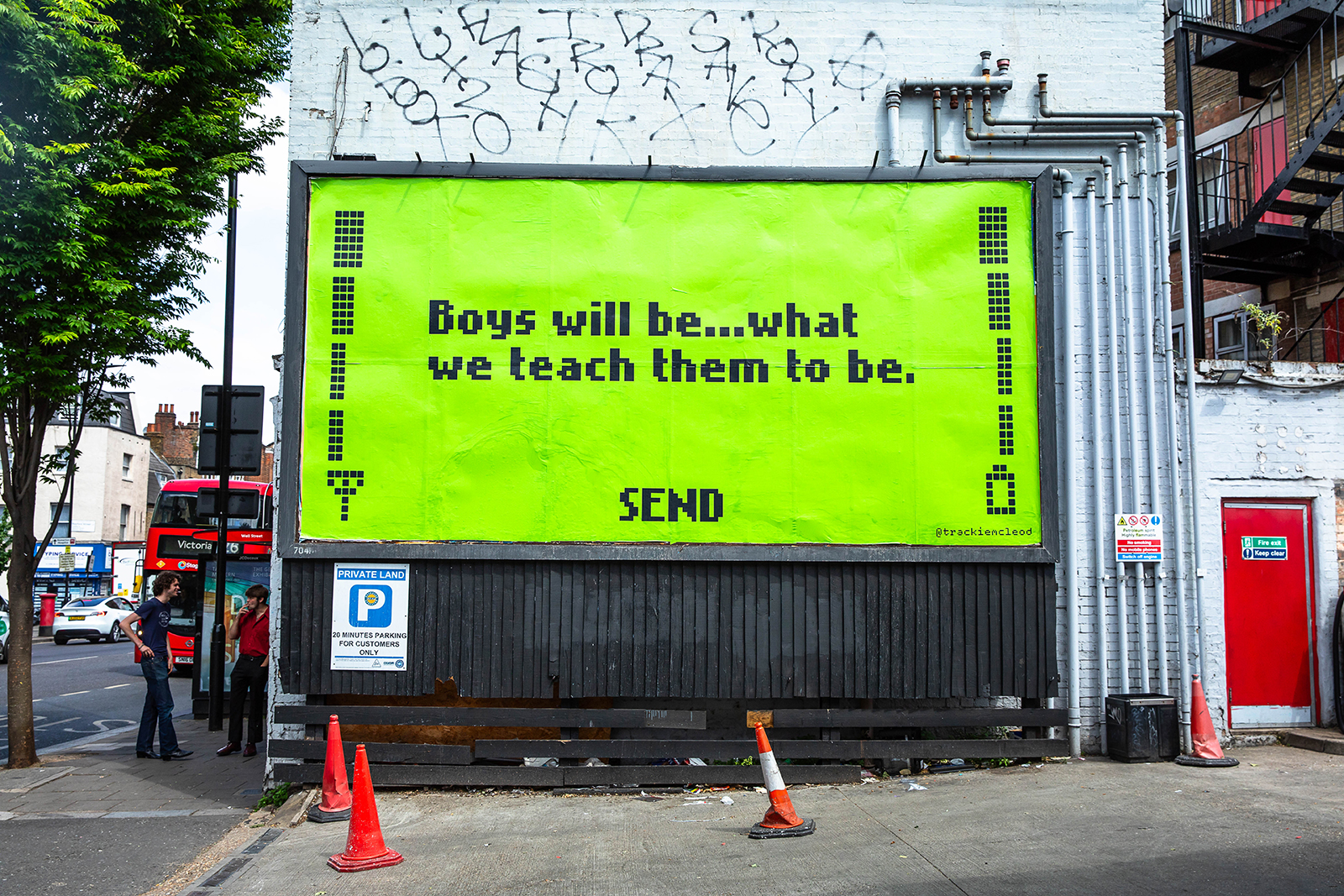
Quick take: Artist Trackie and BUILDHOLLYWOOD used a London billboard with a Nokia-style flyposted design and the line “Boys will be what we teach them to be” to challenge the idea that masculinity is fixed—reframing it as something learned, practiced, and passed down.
Some messages hit harder when they aren’t framed as “art.” They hit hardest when they appear where people aren’t expecting to reflect—on the way to work, during a bus ride, in the middle of a normal day.
That’s exactly what makes Trackie’s BUILDHOLLYWOOD billboard so effective. It doesn’t ask for attention like a gallery piece. It interrupts attention like a street truth—simple, direct, and impossible to unsee once you’ve read it.
The creative hook: a Nokia-era interface that feels like a text from society
The billboard looks like something lifted from a Nokia 3310: pixel-style typography, retro UI cues, and a flyposted texture that makes it feel lived-in rather than polished.
That design choice isn’t nostalgia for nostalgia’s sake. It does two important things:
- It lowers the “art barrier.” The message feels familiar—like a text you’d receive, not a lecture you’d avoid.
- It reframes the billboard as communication, not advertising. The implied “SEND” energy makes it feel shared, not sold.
And then the line lands:
“Boys will be what we teach them to be.”
A direct rewrite of a phrase society has repeated for generations—now flipped into accountability.
Why it works better on the street than in a gallery
Put this message in a pristine white room and it becomes something you choose to engage with. Put it on a billboard and it becomes something you encounter—whether you planned to or not.
That’s the power of OOH as a cultural platform: it reaches people in the middle of real life, when defenses are down and attention is already moving through public space.
Street placement also democratizes the audience. No tickets. No gatekeeping. No “art crowd.” Just the city.
Masculinity as a learned behavior, not a birthright
The message works because it’s practical, not abstract.
It suggests masculinity isn’t something boys are. It’s something boys are taught—through:
- what adults reward or punish
- what peers reinforce
- what culture normalizes
- what silence allows
In one sentence, masculinity becomes a shared responsibility rather than a fixed identity.
The bigger statement: who gets to speak in public space
Trackie’s work is built to live beyond institutions. It doesn’t rely on art-world validation to matter. It’s designed for visibility, friction, and conversation—where meaning spreads through repetition and shared sight.
OOH becomes the perfect medium for this approach because it’s inherently public. A billboard doesn’t ask permission from the viewer. It simply exists—and the city becomes the distribution system.
The uncomfortable truth behind independent art
As the work travels further—both online and on the street—the economics behind it remain difficult. Trackie highlights the pressure working-class artists face: space, materials, production time, and the constant need to fund the next piece.
It’s an important reminder: cultural impact can scale quickly, but financial stability often doesn’t.
What this signals for modern OOH
This collaboration shows OOH functioning as cultural infrastructure—not just commercial inventory.
When public media is used to:
- challenge norms
- humanize complex topics
- spark real conversation
…it creates an emotional reach that traditional advertising can’t buy.
Sometimes the most powerful use of a billboard isn’t persuasion. It’s reflection.
FAQs
What is the “modern masculinity” billboard about?
A BUILDHOLLYWOOD collaboration with Trackie featuring a Nokia-style flyposted design and the line “Boys will be what we teach them to be,” reframing masculinity as learned behavior.
Why is the message stronger in public space?
Because the street creates surprise and accessibility—reaching everyday audiences who wouldn’t necessarily seek the message in a gallery.
What makes the creative instantly recognizable?
The Nokia-inspired layout, pixel typography, flyposted texture, and text-message framing.
How does this relate to OOH culture?
It shows OOH can distribute ideas—not only ads—turning billboards into platforms for public dialogue.
What challenge does the artist highlight behind the work?
The financial reality of independent art: visibility doesn’t automatically create stability.
Bottom line
This billboard proves that when OOH is used as a space for ideas—not instructions—it can reshape how culture is discussed in public. Not by shouting, but by stating something simple, true, and impossible to ignore.

Comments (0)
Join the conversation. Keep it respectful and on-topic.