
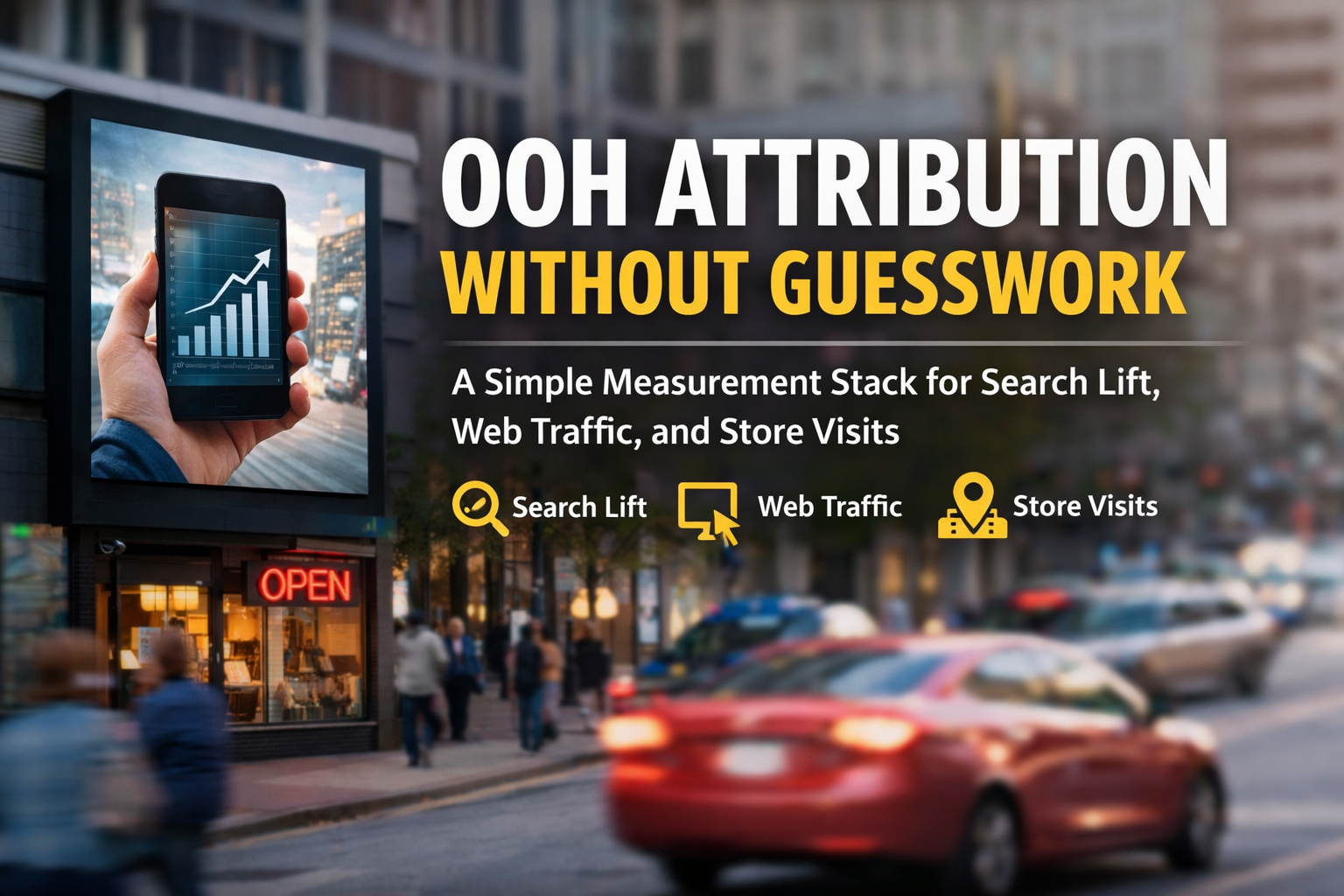
Quick Answer: You can measure OOH without pretending it’s a click channel. The most reliable approach is a stacked measurement model—combining baseline tracking, geo tests, search lift, store visits, and incrementality methods that match the real-world nature of OOH exposure.
OOH drives outcomes—just not in the same way a banner ad does.
People don’t tap a billboard. They remember it, talk about it, search for it, or act on it later. Effective OOH measurement focuses on the signals people actually follow after encountering a message in public space.
What OOH typically influences
Strong OOH campaigns tend to lift a predictable set of downstream behaviors:
- Branded search volume
- Direct website traffic
- App installs (especially with clear prompts)
- Store visits and footfall
- Conversion lift in exposed geographies
The mistake is looking for all of this in a single metric. The solution is layering signals.
A practical five-layer OOH measurement stack
1) “Always-on” baseline tracking
Before a single board goes live, establish a baseline. This becomes your reference point for lift.
Track weekly:
- Branded search volume
- Direct traffic
- Conversion rate
- Geographic performance by market
Without a baseline, everything else becomes guesswork.
2) Vanity URLs (only when they make sense)
Vanity URLs can be useful—but only in environments where stopping or waiting is realistic.
Best used in:
- Transit shelters
- Retail environments
- Street furniture with dwell time
Avoid them on highways or high-speed corridors. Recognition beats recall in those environments.
3) Geo lift testing (the cleanest method)
Geo testing remains the most defensible way to measure OOH impact.
Split markets into:
- Exposed zones — where OOH is active
- Control zones — similar markets with no exposure
Measure differential lift over time across search, traffic, and conversions. This isolates OOH impact without relying on clicks.
4) Store visit measurement
If you have access to partners or internal location data, OOH becomes even more measurable.
- Compare visits in exposed corridors vs control areas
- Align visit spikes with delivery schedules
- Evaluate time-of-day effects against dayparting
This is where OOH often proves its strongest business impact.
5) Incrementality mindset
The most important measurement shift is philosophical.
Ask: “What changed because OOH existed?”
Not: “How many clicks did a billboard get?”
OOH measurement is about lift, not attribution ownership.
Reporting that stakeholders actually accept
The best OOH reports are simple and defensible.
- What ran — where and when
- What moved — search, traffic, visits, conversions
- What it suggests — how to optimize corridors, dayparts, or creative
When reporting focuses on business movement—not platform metrics— stakeholder confidence increases.
FAQs
Can OOH be attributed to conversions?
Yes—through geo tests, lift studies, and store visit measurement. Not through last-click attribution.
Are QR codes required to measure OOH?
No. Many high-performing OOH campaigns generate measurable impact through search lift and direct traffic alone.
What’s the biggest OOH measurement mistake?
Trying to measure OOH like a digital ad instead of a real-world exposure channel.
Bottom line
OOH doesn’t need guesswork—it needs the right measurement lens.
When attribution is built around real-world behavior, OOH becomes one of the most trustworthy channels in the mix.









Comments (0)
Join the conversation. Keep it respectful and on-topic.