
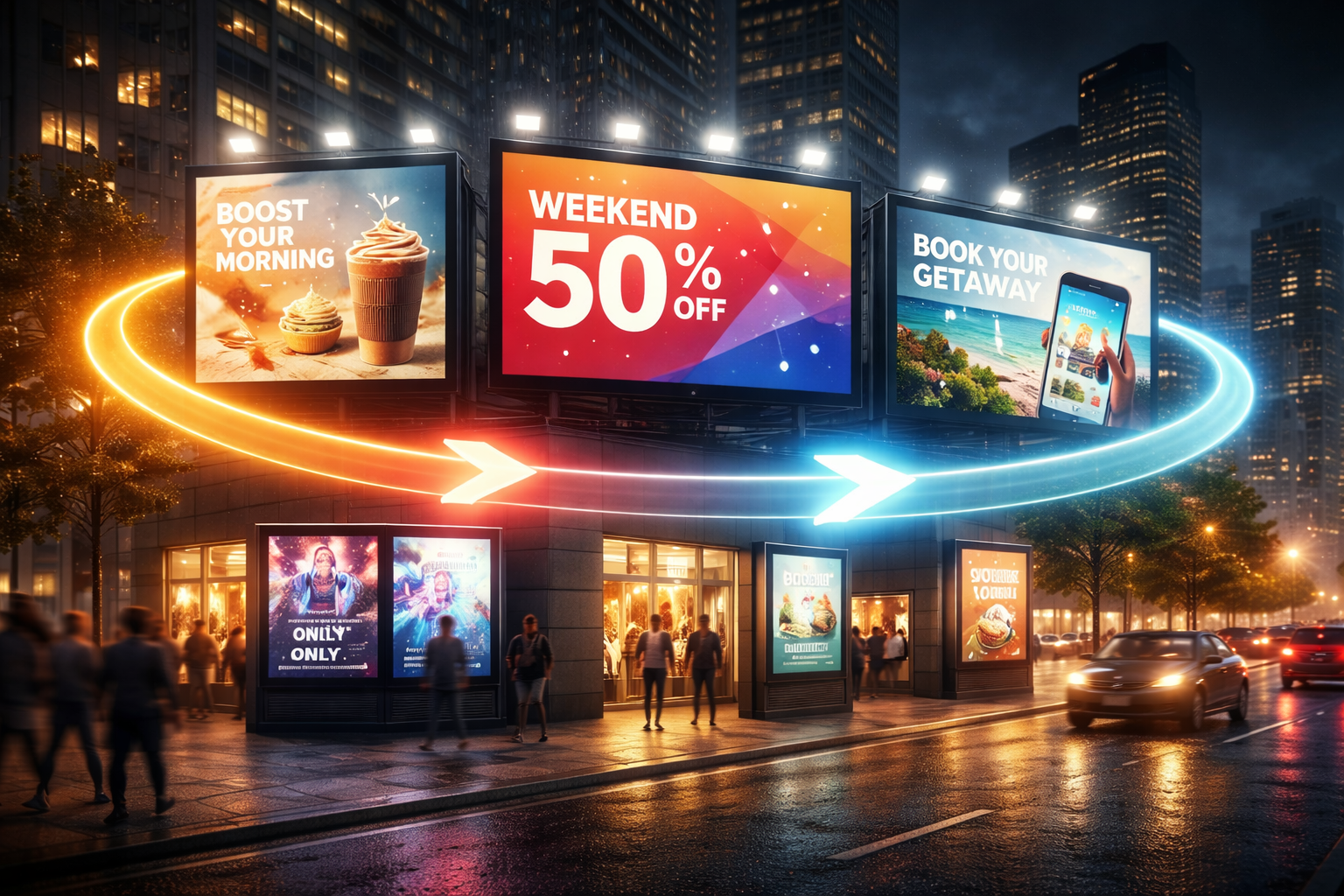
Creative fatigue is real—even in OOH.
OOH is high impact, but it’s also repetitive by nature. The same commuter can pass the same units multiple times per week. That repetition is a strength—until the message becomes invisible.
In 2026, the brands that win OOH aren’t necessarily the ones with the biggest spend. They’re the ones who manage message freshness like a system.
Why rotating creative increases efficiency
When you refresh creative on a structured cadence, you can:
- Maintain attention instead of blending into the background
- Test multiple offers or angles without starting from scratch
- Improve downstream metrics (search lift, web traffic, store visits) because the message stays “alive”
- Avoid overpaying for frequency that no longer moves behavior
The 3-layer creative rotation framework
Layer 1: The “core idea” stays consistent
This is what should remain stable:
- Brand codes (colors, product, logo position)
- One core promise (the thing you want remembered)
Layer 2: The “message module” rotates
Rotate one of these, not all:
- Headline
- Offer
- Proof point
- CTA (search, download, visit, order)
Layer 3: The “context module” rotates fastest (DOOH)
If you’re using DOOH, rotate:
- Daypart lines (“Morning commute” vs “Tonight”)
- Local references (“Downtown” vs “Midtown”)
- Real-time triggers (weather, events) where relevant
How often should you rotate?
A practical planning rule:
- Static OOH: every 4–8 weeks (depending on flight length and audience frequency)
- DOOH: every 1–2 weeks for the message module, daily or hourly for the context module
- High-frequency commuter corridors: rotate sooner (fatigue happens faster)
A simple refresh plan (that doesn’t explode production costs)
- Build a master template (brand codes locked)
- Produce 3 headline variants + 2 offers (that’s 6 combos)
Assign:
- Variant A to Weeks 1–2
- Variant B to Weeks 3–4
- Variant C to Weeks 5–6
Keep the final 2 weeks for the best performer.
What to measure to decide refresh timing
Even if you don’t have perfect attribution, track:
- Brand search volume in markets with active OOH
- Direct traffic spikes
- Store visitation lift (where available)
- Creative-level delivery + daypart reporting (DOOH)
Bottom line
OOH doesn’t need more complexity—it needs smarter repetition. In 2026, creative rotation is how you turn frequency into performance, not wasted impressions.

Comments (0)
Join the conversation. Keep it respectful and on-topic.