
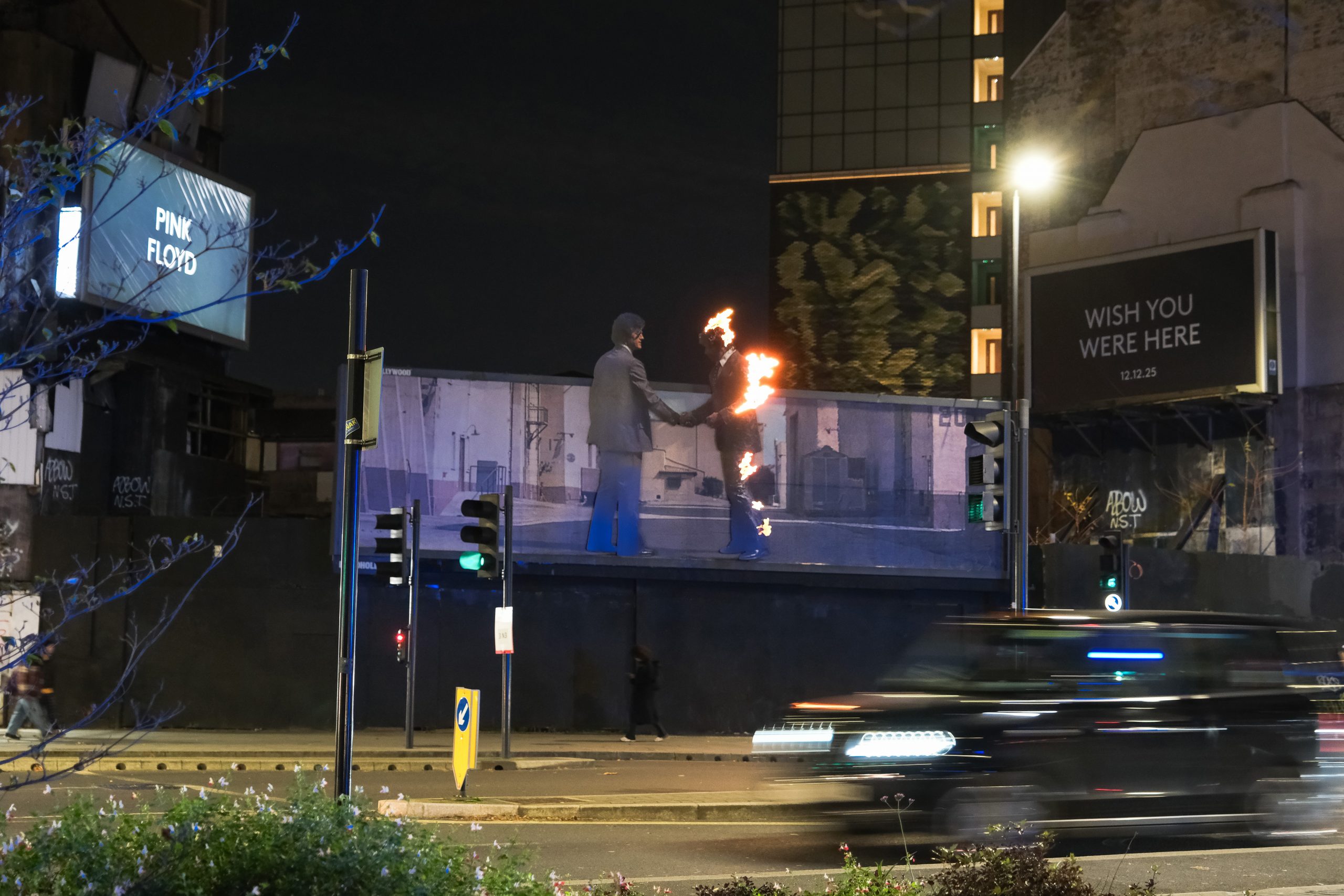
Quick take: To mark the 50th anniversary of Wish You Were Here, an OOH installation in London recreated the album’s legendary handshake scene—complete with a dramatic “on fire” effect after dark—turning album art into a public spectacle.
Some album covers don’t just represent music—they become cultural symbols. Pink Floyd’s Wish You Were Here is one of them: the handshake, the suit, the flames. You don’t need to be a superfan to recognize it. You just need to have lived in the world long enough for it to have reached you.
That’s why this London activation worked so well. Instead of printing the cover on a poster and calling it a tribute, the campaign pulled the artwork into real space—turning a familiar street environment into a live, shareable scene that people could encounter in person.
Developed by DIABOLICAL with media agency The7Stars, and executed with BUILDHOLLYWOOD, the piece shows what happens when OOH stops being a format and starts acting like culture.
The creative move: don’t show the cover—stage it
The original cover’s power comes from tension: a friendly handshake with hidden danger. Translating that into OOH meant recreating the composition in a way that felt instantly recognizable.
The installation reproduced the scene of two men shaking hands—with one figure appearing engulfed in flames—so accurately the message didn’t need copy. The artwork became the headline.
And that’s the key: when an image is this iconic, the job isn’t to explain it. The job is to trigger recognition instantly.
The night-time flame effect made it feel “alive”
This wasn’t just a static recreation. The installation was designed to hit harder after sunset, using lighting and flame-like effects to make the burning figure feel vivid at night.
That time-based shift matters in OOH because it creates a second wave of impact:
- daytime: curiosity + recognition
- nighttime: spectacle + sharing
When something changes with the environment, people stop and look longer—because it feels like a live moment, not a printed message.
Why the location strategy mattered
The takeover ran in a high-visibility corridor near Westminster Bridge, using a large 96-sheet format. That placement choice does a lot of work:
- heavy footfall + traffic means constant discovery
- the city backdrop adds cinematic credibility
- iconic London geography amplifies the “event feel”
In other words: it doesn’t feel like a poster you pass. It feels like something happening in your city.
A music anniversary that behaves like an event, not a commemorative ad
Anniversary marketing can easily become nostalgic wallpaper—safe, predictable, and forgettable.
This activation avoided that by treating the anniversary like a cultural milestone worth staging publicly. Wish You Were Here first released in 1975, and the campaign timing aligns with the 50-year celebration window. That framing turns the work into something bigger than promotion: a public tribute people can physically experience.
When OOH becomes live storytelling, it earns attention differently
What this activation demonstrates is simple: OOH can do more than carry a message—it can create a moment.
And moments generate:
- organic photos
- social posts without paid prompts
- emotional reactions rooted in real memory
- cross-generational recognition
It’s an example of outdoor at its best: it respects the audience’s intelligence. It doesn’t over-explain, it doesn’t shout—it places something culturally meaningful in public space and lets people do the rest.
Why it resonated
This execution had three high-performing ingredients for public environments:
- Immediate recognition (iconic image)
- Emotional nostalgia (music history + personal memory)
- Visual surprise (nighttime flame effect)
That combination is hard to beat—because it lands fast, feels personal, and gives people a reason to capture it.
FAQs
What is the Pink Floyd Wish You Were Here OOH activation?
A London installation recreating the iconic album cover handshake scene, including the signature “man on fire” moment.
Who developed the work?
Developed by DIABOLICAL with media agency The7Stars, with BUILDHOLLYWOOD involved in execution.
Where did it run?
In London, in a high-visibility area near Westminster Bridge, using a large-format 96-sheet takeover.
Why does it stand out?
Because it turns legendary album art into a physical, night-reactive public moment—more like a live tribute than a standard billboard.
What can marketers learn from it?
When you tap a cultural icon and translate it into real-world spectacle, OOH becomes instantly memorable—and often earns organic reach without forcing it.

Comments (0)
Join the conversation. Keep it respectful and on-topic.