
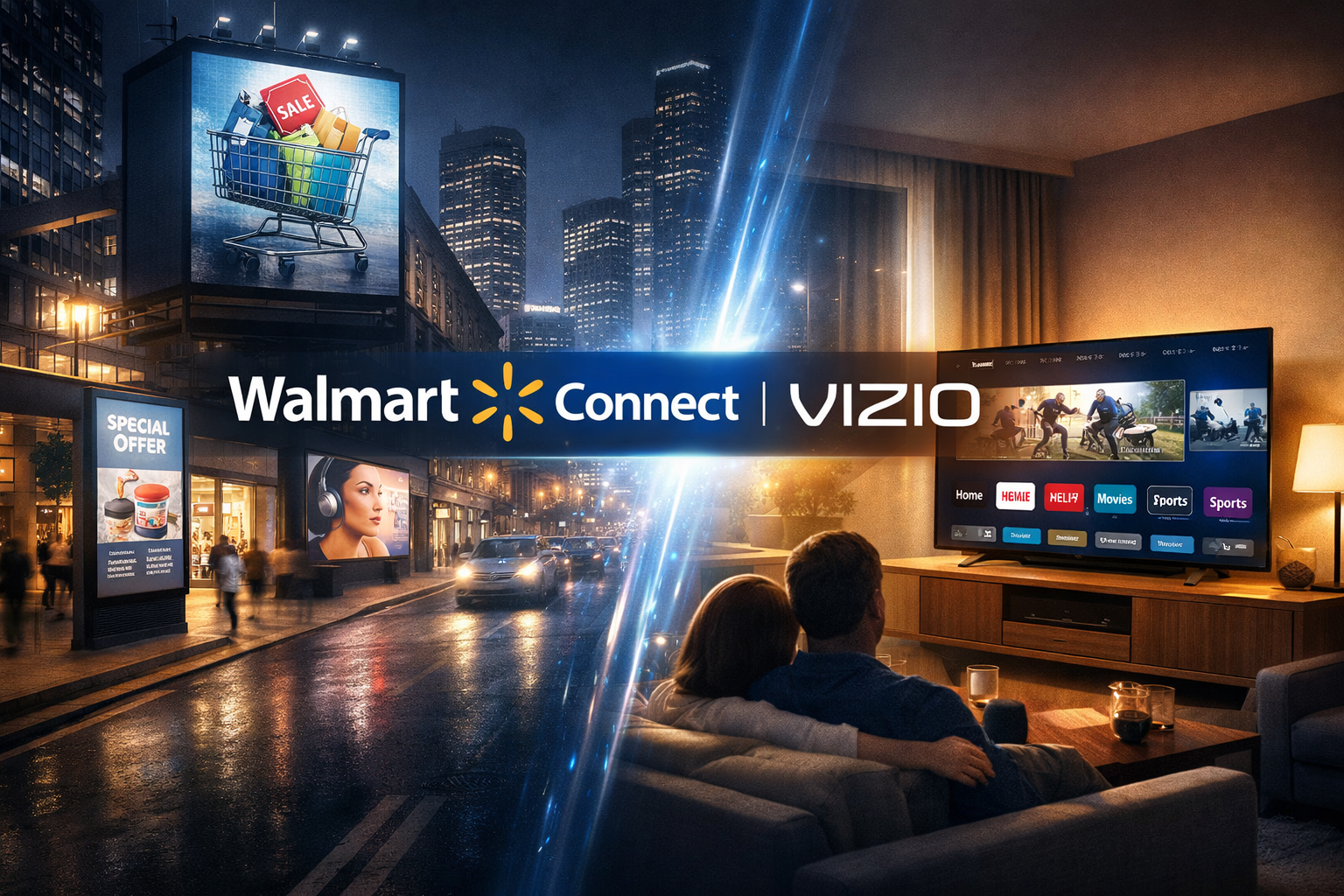
Retail media is absorbing channels—starting with TV.
Walmart’s acquisition of VIZIO is a major signal: retail media networks don’t want to be “a line item.” They want to be a full-funnel media company.
Walmart confirmed it completed the acquisition of VIZIO and its SmartCast operating system, following the deal announced earlier in 2024.
Industry analysis also frames this as strengthening Walmart’s “ad flywheel” by connecting retail media with CTV-scale opportunity.
Why this matters to OOH and DOOH buyers
When a retailer controls:
- shopper data signals
- off-site ad distribution
- in-home CTV surfaces
- in-store touchpoints
…it changes how planners should design campaigns.
OOH and DOOH become more valuable—not less—because they can serve as the high-impact, real-world ignition layer that pushes people into:
- branded search
- store visits
- online carts
- app installs
- eventually, in-home CTV reinforcement
The new omnichannel sequence: Street → Store → Screen
A modern retail-driven journey can look like this:
- DOOH builds awareness and urgency in high-movement corridors
- Mobile + Search capture intent immediately after exposure
- Retail media off-site reinforces offer and availability
- In-store screens and shelf moments reduce friction
- CTV / in-home closes the loop through retargeting and storytelling
This is where OOH becomes strategically critical: it creates public proof at scale, which improves downstream conversion efficiency across digital.
What changes in media planning because of VIZIO
1) Retail media becomes a reach channel
Historically, retail media was “lower funnel.” As it expands into CTV, it becomes capable of broader reach—while still retaining purchase-linked measurement narratives.
2) Measurement expectations rise across the board
If retailers can talk about outcomes, every channel in the mix gets questioned:
- What did OOH drive in search?
- What lift did it create in store visitation?
- How did it change conversion rates in exposed markets?
That’s where shared measurement frameworks (like IAB’s DOOH measurement guidance) help keep OOH/DOOH planning credible and comparable.
3) Creative must be consistent across environments
The winners in 2026 won’t be the brands that “run OOH” and “run retail media.” They’ll be the brands that run one unified idea across:
- street-level impact
- retail moments
- in-home reinforcement
The 2026 takeaway: retail media makes OOH more accountable
OOH doesn’t need to pretend to be digital. But it does need to prove its role in outcomes—especially when retail media ecosystems set the standard for performance language.

Comments (0)
Join the conversation. Keep it respectful and on-topic.