
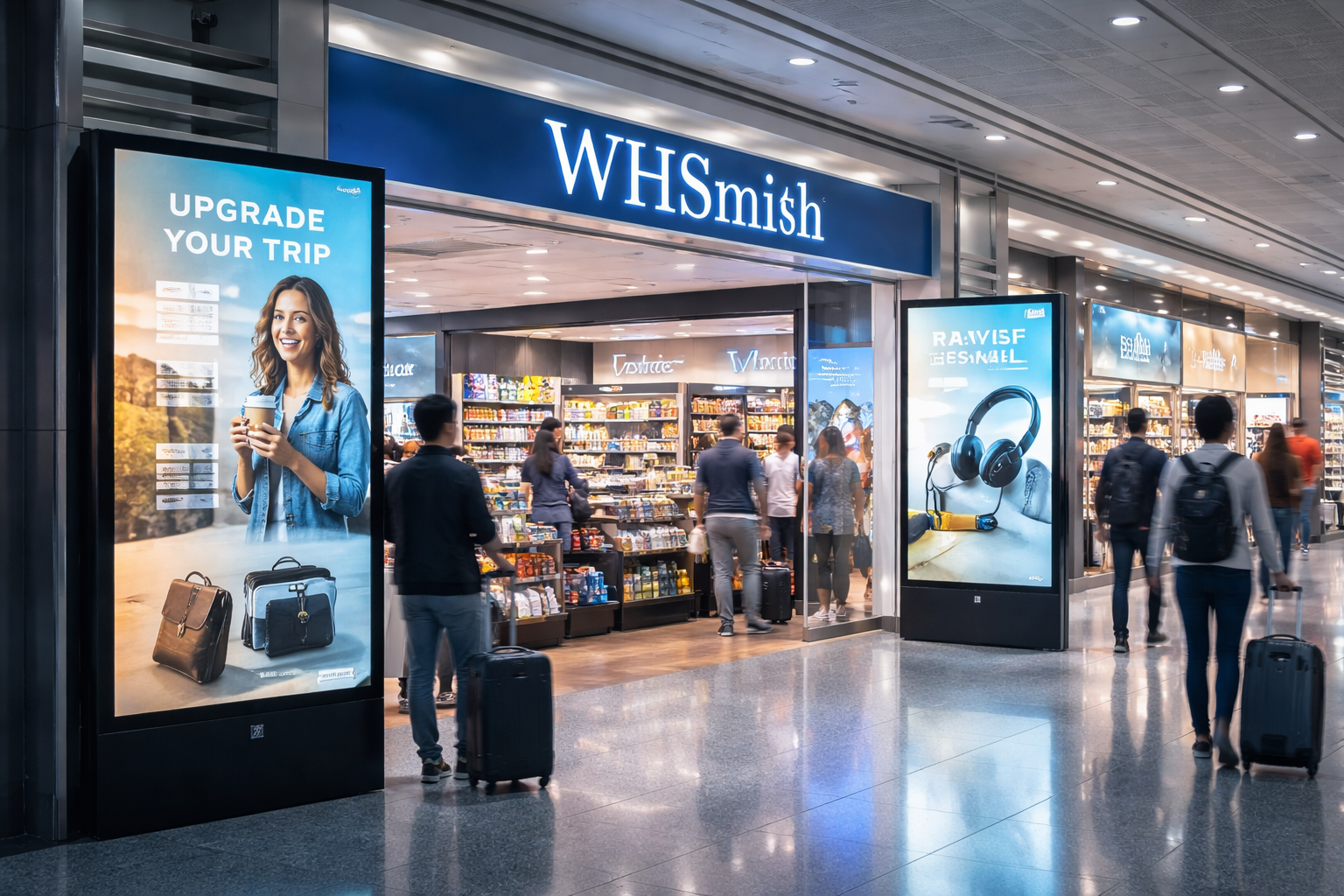
Quick Answer: :contentReference[oaicite:0]{index=0} North America Media Network is partnering with :contentReference[oaicite:1]{index=1} (ISM) to launch a programmatic airport retail media network across more than 350 U.S. airport stores, combining approximately 700 in-store digital screens and in-store audio into a single buyable ecosystem.
Airports have always been premium media environments. What’s changing is how they get bought.
WHSmith’s move with ISM signals a clear shift: airport retail locations are no longer just place-based DOOH screens. They’re becoming retail media networks—with programmatic access, unified inventory, and planning logic that looks closer to digital media than traditional OOH.
What’s actually launching
According to official announcements and industry coverage, the new network will span more than 350 airport retail locations across the United States.
The rollout brings together roughly 700 digital screens alongside in-store audio, all accessible through a single programmatic buying layer. ISM will serve as the inventory and programmatic platform powering the network.
In practical terms, this means airport retail media becomes easier to buy, easier to scale, and easier to integrate into broader omnichannel plans.
Why airport retail media is suddenly a big deal
Airport audiences are often labeled as “high income,” but their real value goes further:
- High dwell time — longer exposure windows than street-level OOH
- High intent — shopping, gifting, convenience, and last-minute purchases
- High repetition — frequent flyers revisit the same terminals repeatedly
When those audience traits are combined with a unified network of screens plus audio, planners get something especially powerful: frequency with context.
Why screens + audio changes the strategy
Most DOOH plans are visual-first. Adding audio introduces a second layer of influence.
- Reinforces recall without requiring constant screen attention
- Creates continuity across multiple touchpoints within a store
- Enables message sequencing across the shopping journey
This starts to feel less like a simple ad loop and more like mini-channel programming inside the airport retail environment.
The real shift: airport DOOH becomes DSP-native
The most meaningful implication of this launch is that airport DOOH moves beyond isolated placements and into a programmatic, DSP-friendly model.
That matters because it allows airport media to plug more naturally into:
- Omnichannel planning
- Standardized reporting and measurement
- Dynamic scheduling and optimization
For buyers, airport retail DOOH starts behaving less like a special exception and more like a scalable media channel.
Creative guidance for airport retail DOOH
Creative that performs in this environment should think like a traveler:
- Fast decoding — 3–5 words that land instantly
- Utility + emotion — “ready-to-go,” “upgrade your trip,” “you forgot this”
- Category relevance — snacks, tech accessories, beauty, wellness, travel essentials
- Dayparting — morning departures and evening returns feel very different
What marketers should watch next
If this ecosystem scales successfully, expect:
- Airport retail media sold more like RMN inventory
- Premium pricing tied to store density and terminal traffic
- Improved measurement as networks become standardized
FAQs
What is WHSmith launching in the U.S.?
A programmatic airport retail media network across 350+ airport stores, combining approximately 700 digital screens with in-store audio.
Who is powering the programmatic platform?
In-Store Marketplace (ISM).
Why does this matter for DOOH buyers?
It moves airport DOOH into a unified, programmatic retail media network model, making it easier to plan, buy, and measure at scale.
Bottom line
This launch represents more than a new network. It signals how airport DOOH is evolving—toward retail media logic, programmatic access, and channel-based thinking.
For buyers, airport media is becoming less about isolated placements and more about consistent, high-value presence in moments that matter.






Comments (0)
Join the conversation. Keep it respectful and on-topic.