
Quick Answer
WWF and NOMINT launched the Science of Hope creative platform for the Living Planet Report 2026, using OOH advertising, eight films directed by Joana Sus and direct mail. Wildlife photography, handwritten poetry and collage-style compositions communicate biodiversity loss while emphasizing that collective action can support nature’s recovery.
Build Purpose-Driven OOH Advertising Campaigns With Local OOH
Out-of-Home Advertising (OOH) gives organizations an opportunity to connect important ideas with people in everyday public spaces. From Outdoor Advertising and posters to high-impact billboards, carefully chosen physical media can make complex subjects more accessible. Explore impactful OOH campaign opportunities with Local OOH.
WWF Living Planet Report 2026 Takes the Science of Hope Into Outdoor Advertising
For the launch of the Living Planet Report 2026, WWF partnered with creative studio NOMINT to introduce The Science of Hope, a platform that uses poetry and handmade visual language to communicate the state of the natural world.
The integrated campaign combines OOH Advertising, eight master films directed by Joana Sus and direct mail. WWF International and local offices are rolling out the creative across the year.
Rather than focusing only on ecological decline, the work draws attention to nature’s capacity to recover when people take sustained, collective action.
Creative OOH Advertising Transforms Wildlife Conservation Data Into Visual Poetry
The report is published every two years and includes the Living Planet Index, which has tracked changes in monitored wildlife populations since 1970. The campaign translates this scientific context into accessible, emotional stories of loss and recovery.
Its Outdoor Media executions combine wildlife photographs, torn-paper collage effects and handwritten poems. These craft-inspired details make the work visually distinct while leaving the animals—and the conservation messages—at the center of the composition.
Bluefin Tuna OOH Campaign Highlights Recovery Through Collective Action
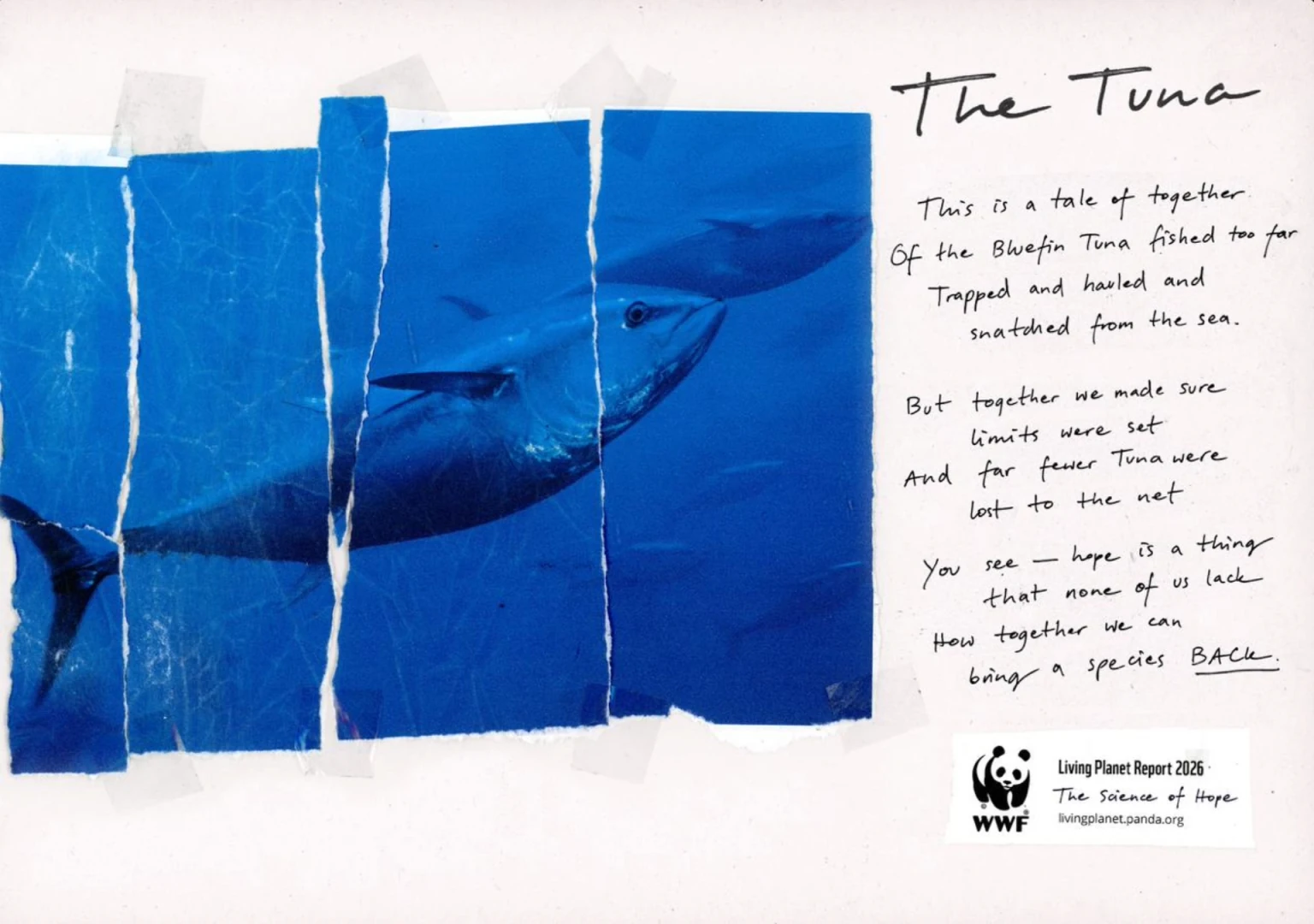
One execution, titled The Tuna, uses an image of a bluefin tuna split across torn photographic strips. Alongside it, a handwritten poem describes how shared action and fishing limits can help a species recover.
In Billboard Advertising and printed OOH formats, this type of juxtaposition invites a second look: the dramatic underwater photography attracts attention, while the handwritten message introduces the broader conservation story.
Discover storytelling opportunities in outdoor advertising with Local OOH
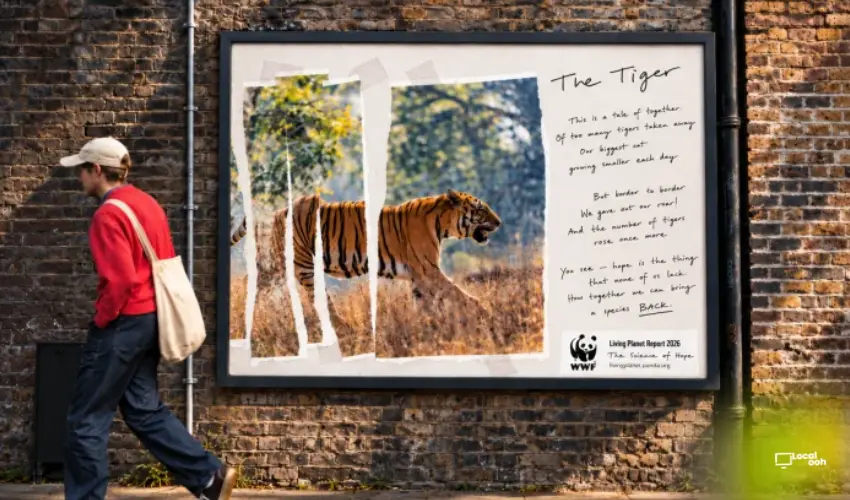
Tiger Outdoor Advertising Poster Makes Wildlife Recovery Visible on the Street
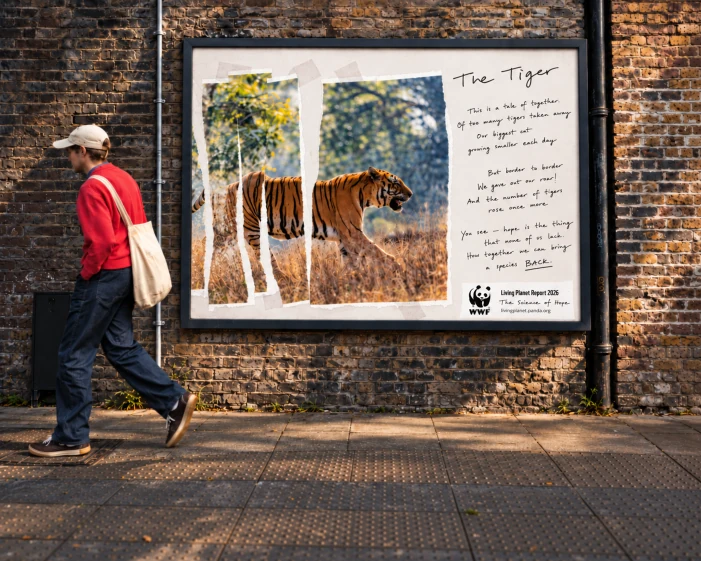
The campaign’s tiger execution brings the same creative identity into a photographed street-level advertising frame. A passerby walks beside an OOH poster featuring tiger photography, a handwritten poem and the WWF branding for the Living Planet Report 2026.
This installation demonstrates why physical Out-of-Home Media matters for public-interest campaigns: environmental messages appear in the everyday setting of streets and neighborhoods, not only in digital feeds.
Integrated OOH Campaign Connects Outdoor Media, Films and Direct Mail
NOMINT led creative strategy, concept development, production and execution. Its eight master films, directed by Joana Sus, sit alongside the campaign’s OOH and direct-mail components.
This integrated approach helps give the message a coherent visual identity across touchpoints: photography, poems and handmade elements signal the same narrative whether audiences encounter the campaign on the street or in other media.
The supplied campaign information confirms OOH advertising, but does not establish that the photographed executions use DOOH screens or Programmatic DOOH (pDOOH). The creative is therefore described as physical outdoor advertising rather than being mislabeled as a digital placement.
Why This Wildlife Conservation OOH Campaign Stands Out
The creative does not attempt to turn scientific findings into a single oversized statistic. Instead, it uses emotionally resonant stories to help people understand that conservation is a process in which action matters.
That makes the campaign an effective example of Purpose-Driven OOH Advertising: the public placement captures attention, while the combination of narrative and evidence gives viewers a reason to engage beyond the initial visual.
What Brands and Nonprofits Can Learn From WWF’s Outdoor Advertising Campaign
- Make complex information human. Storytelling can help audiences connect with environmental science.
- Use authentic visual craft. Collage and handwritten typography distinguish creative OOH from conventional promotional posters.
- Use public space for public-interest communication. A street-level poster can expose new audiences to conservation messages.
- Connect media channels through one idea. Consistent visual language can unify OOH, films and direct mail.
Final Reflection: WWF Shows How OOH Advertising Can Bring the Science of Hope to Life
The WWF Living Planet Report 2026 OOH Campaign makes nature’s challenges more immediate while reminding audiences that recovery is possible through collective action. With NOMINT’s handcrafted creative system, the campaign presents conservation as a story that can still be changed.
It also shows the potential of Outdoor Advertising to carry meaningful public messages in visually memorable ways.
Summary
WWF’s Living Planet Report 2026 campaign turns environmental data into poems and visual stories through a global integrated campaign. Creative studio NOMINT developed a framework spanning OOH posters, films and direct mail. The supplied images show a bluefin tuna conservation artwork and a tiger poster installed in a street-level frame, making the campaign’s conservation message tangible in public space.
Sources
Campaign information and visuals were provided for this article. No independently verified campaign performance metrics were supplied.
FAQs
What is WWF’s Science of Hope OOH campaign?
It is a WWF and NOMINT campaign for the Living Planet Report 2026, using outdoor advertising, poetry, films and direct mail to share stories about nature’s decline and capacity to recover.
What is the Living Planet Report 2026?
It is WWF’s biennial report about the state of nature, informed by the Living Planet Index, which tracks changes in monitored wildlife populations.
Who created the WWF OOH advertising campaign?
Creative studio NOMINT developed the campaign with WWF, including its creative strategy and executions. Joana Sus directed the eight master films.
Does the campaign use DOOH or programmatic advertising?
The supplied campaign details confirm OOH advertising, but do not establish that the pictured posters use DOOH or programmatic DOOH.

Comments (0)
Join the conversation. Keep it respectful and on-topic.