
Quick Answer: For real estate in 2026, digital billboards aren’t just about reach—they’re about trust at scale. The National Association of REALTORS® (NAR) recently published guidance that frames the goal clearly: buyers and sellers don’t just want listings; they want confidence in the person behind the listing. That’s exactly where OOH (and especially DOOH) can outperform “online-only” visibility—because outdoor creates public proof that feels real in the physical world.
NAR’s guidance focuses on how agents can create a stronger immediate connection by introducing themselves in a more human way before the first call, tour, or inquiry. The underlying insight is simple: credibility is often invisible online. Anyone can look big in a feed. Outdoor is different—when people see you in the real world, repeatedly, in their own city, it signals legitimacy, permanence, and local commitment.

Why OOH works for real estate (and other trust categories)
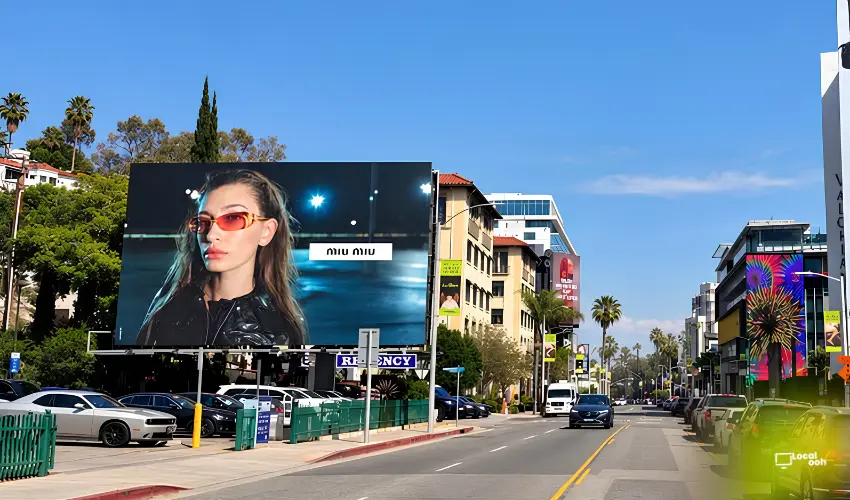
Real estate is a high-stakes decision. People don’t just choose a home—they choose a guide. That’s why awareness alone isn’t enough. You need a signal that says: “I’m established here. I’m real. I’m the safe choice.” A billboard does that because it’s verifiable presence. Your name isn’t just “targeted” to someone; it’s visible to everyone. That visibility becomes social proof.
And this isn’t limited to agents. The same trust logic applies to mortgage, insurance, legal services, healthcare, and local home services. When decisions are expensive, emotional, or risky, the winning move is often to remove uncertainty before the first conversation.
DOOH adds the modern advantage: flexibility
The biggest upgrade in 2026 is that DOOH turns one placement into a living channel. Instead of locking into one printed message, an agent can rotate:
- Brand identity (name, niche, neighborhood focus)
- Listing highlights (select inventory moments)
- Seasonal triggers (buying/selling windows, rate shifts, school-year moves)
- Community positioning (local expertise, credibility cues, years in market)
This keeps campaigns consistent while letting creative evolve weekly—perfect for markets where inventory and buyer urgency change fast.
The full-funnel effect: recognition → search → contact
OOH is often the spark. A strong digital billboard creates recognition. Recognition drives search. Search drives inbound. The conversion friction drops dramatically when your outdoor message and online presence match—same name, same promise, same visual identity, and a clean path to contact. In practice, many real estate campaigns win not by shouting “Call now,” but by making “search me” feel inevitable.
How to structure a real estate DOOH strategy
1) One core promise
Pick one claim people can repeat: “Local expert,” “Luxury specialist,” “Fast closings,” “First-time buyer guide,” or “Relocation specialist.” One promise beats five features.
2) High-frequency coverage
Use commuter corridors and neighborhood routes for repeat exposure. Trust is built through familiarity, and familiarity is built through frequency.
3) Consistent branding
Same headshot/brand mark, same color system, same message rhythm. Consistency is what turns “I saw that” into “I know who that is.”
Bottom line
For real estate, outdoor isn’t about impressions—it’s about trust at scale. DOOH turns local visibility into a credibility advantage competitors can’t easily fake, accelerating the path from first sight to first search to first message.
Primary source: NAR — “Your Digital Billboard: Introducing Clients to the Agent Behind the Listing” (Jan 28, 2026).

Comments (0)
Join the conversation. Keep it respectful and on-topic.