
Quick Answer
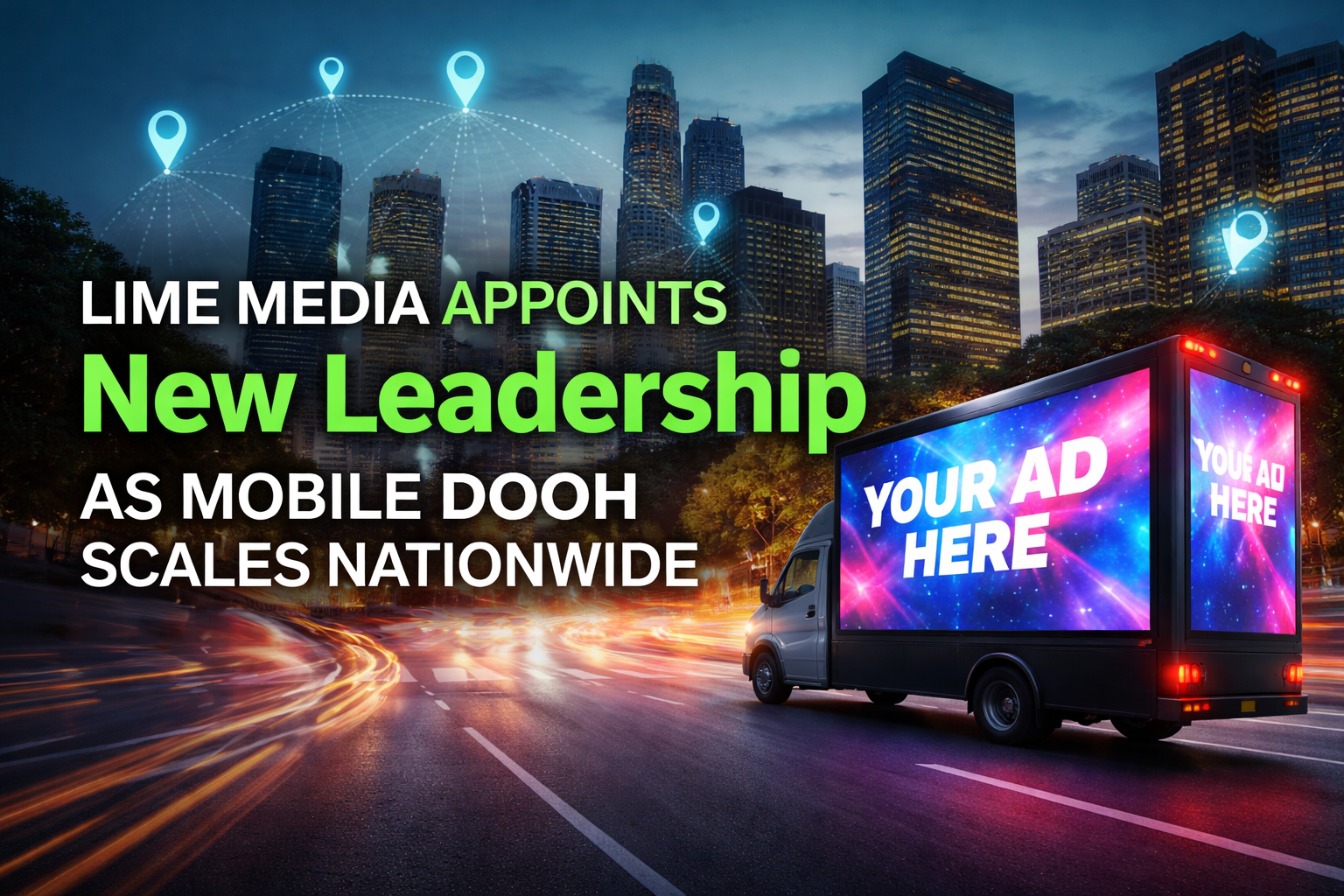
Lime Media appointed new leadership to support growth in mobile LED billboard trucks.
For advertisers, this signals a more scalable, standardized buying experience for mobile DOOH.
What changed at Lime Media
Lime Media announced key leadership appointments: Bart McCollum as President and Spencer Rose as Chief People Officer/Head of Teams & Talent—positioning the company to scale operations, people, and execution as mobile DOOH demand grows.
Why leadership hires matter for mobile DOOH buyers
For agencies and brands, leadership moves are a signal: mobile DOOH is maturing from “nice add-on” to repeatable, scalable inventory with standardized processes. When operators invest in operational infrastructure, you typically see:
-
faster turnaround on routes and permits
-
tighter proof-of-play and reporting
-
better creative QA and fewer field issues
That reduces risk—especially for multi-market campaigns where consistency matters.
Where mobile LED trucks fit versus static & digital billboards
Mobile LED billboard trucks are strongest when you need:
-
hyper-local reach (events, retail corridors, stadium spill zones)
-
high frequency around competitor locations or specific venues
-
daypart strategy (rush hour vs nightlife vs weekend peaks)
They’re not a replacement for large-format billboards; they’re a precision layer that can amplify a market plan—especially when paired with retargeting and lift measurement.
How to buy mobile DOOH like a performance channel
If you want mobile DOOH to behave like modern media, request:
-
target zones (radius lists, POIs, competitor clusters)
-
schedule by daypart + day-of-week
-
content rules (6s/10s/15s loops; CTA versions by zone)
-
measurement plan (exposure proof + lift proxy KPIs)
Lead-gen angle: what to ask for in a quote
To move fast, ask for:
-
recommended routes + estimated impressions
-
minimum booking length and creative specs
-
reporting cadence and example post-campaign report
-
add-ons: social cutdowns, QR tracking, store visit lift (where available)
Summary
Leadership moves in OOH often indicate operational scale and improved execution.
For mobile DOOH, that can mean faster routing, better reporting, and smoother multi-market delivery.
If you’re buying mobile LED trucks for leads, focus on targeting zones, dayparts, and proof-of-play.
Ask for a quote that includes routes, timings, creative specs, and a measurement plan.
Sources
FAQs
Is mobile DOOH better than a billboard?
It’s different: mobile is best for targeted zones and short bursts; billboards win for always-on reach.
What creative works best on mobile LED trucks?
Short copy, big contrast, one CTA, and location-aware variants.
Can I target specific venues or neighborhoods?
Yes—most buys are route/zone-based with daypart controls.
What’s a typical minimum flight?
Often 1–4 weeks depending on market and routing needs (confirm per vendor).
How do I measure results?
Use proof-of-play + geo-lift proxies (QR, web lift, foot-traffic lift if offered).


Comments (0)
Join the conversation. Keep it respectful and on-topic.