
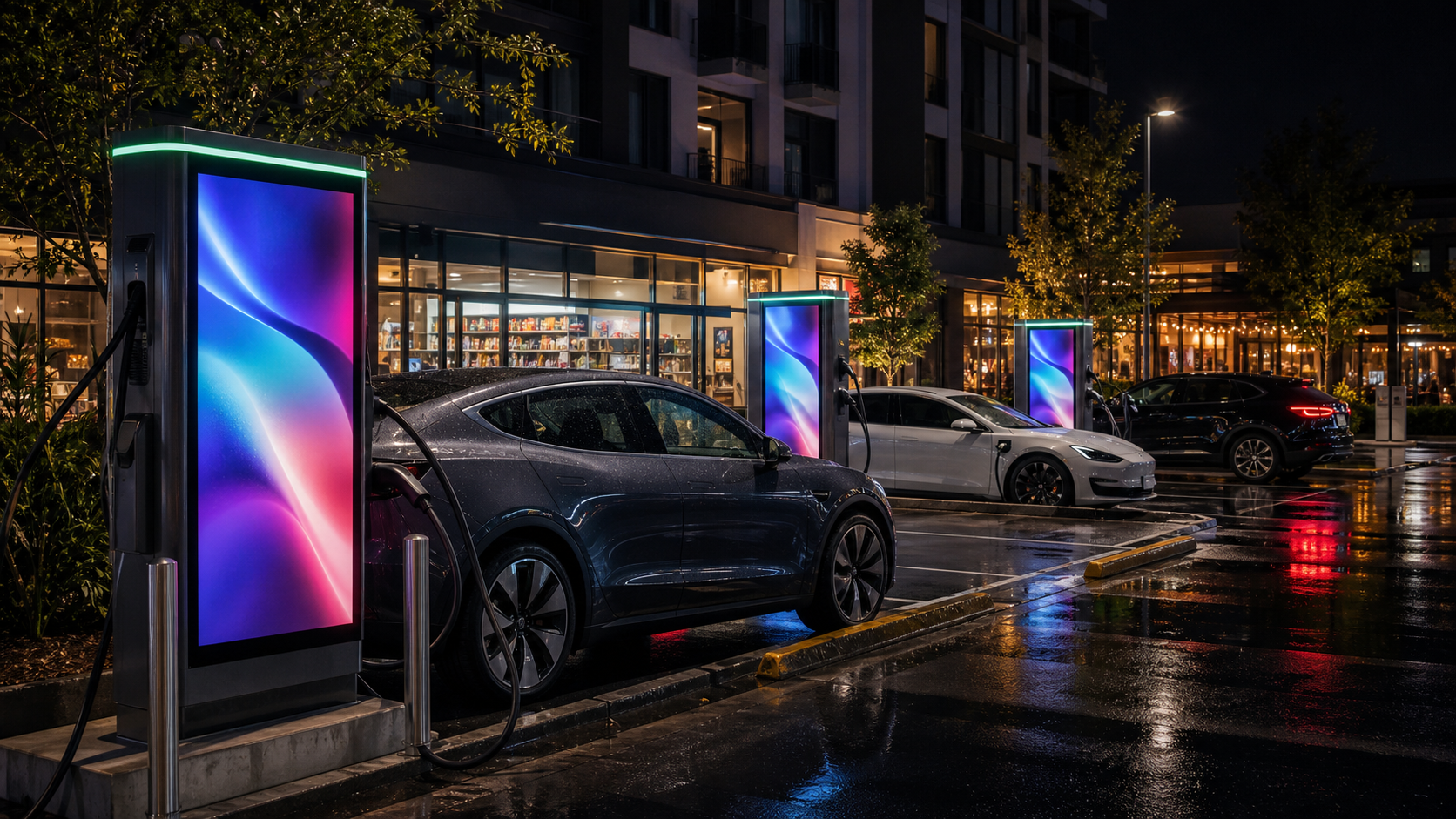
Quick answer: EV charging and forecourt screens give local advertisers a new blend of dwell time, utility, and retail proximity. Here is how to use them without overbuying hype.
A Different Kind of Local Screen
EV charging and forecourt screens are not just smaller billboards. They sit in a pause moment. Drivers may be waiting, walking into a store, checking a phone, or making a convenience purchase. That gives local advertisers a useful context if the message fits the environment.
Best Uses
- Retail and convenience: promotions, food, beverage, quick stops, and nearby services.
- Automotive: dealerships, service, insurance, charging apps, and accessories.
- Local services: healthcare, home services, restaurants, gyms, and neighborhood offers.
- Tourism and events: nearby attractions, parking, hotels, and weekend activity.
The Creative Should Respect the Pause
The viewer is not flying by at highway speed, but the message still needs restraint. Use simple motion, one idea, and context. If the screen is near retail, show the reason to walk in. If it is near a service area, show the useful next action.
How to Measure It
Start with proof-of-play and location lists, then add store visit, offer, search, or QR/landing page signals when appropriate. The key is not to overclaim. EV charging DOOH can be a strong local layer, but it should be measured against the job it was asked to do.
Local OOH Takeaway
EV charging screens are valuable when treated as neighborhood media, not novelty media. Buy them where the dwell moment, nearby businesses, and audience profile make sense.
FAQs
Why are EV charging screens useful for local advertisers?
They combine dwell time, location context, and proximity to retail or service areas.
Are EV charging screens good for every local campaign?
No. They work best when the audience, location, and dwell moment match the product or service.


Comments (0)
Join the conversation. Keep it respectful and on-topic.