
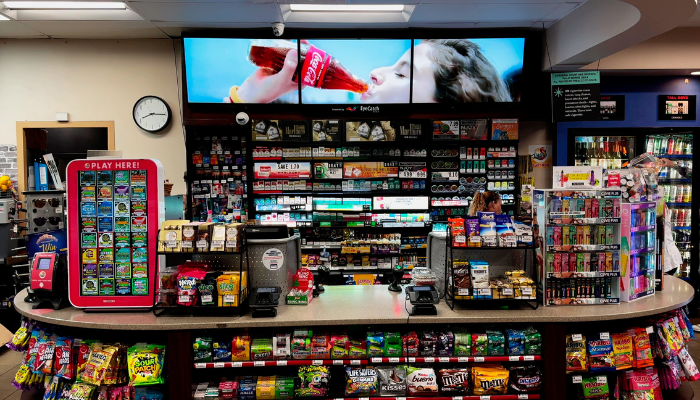
Quick Answer: Independent convenience stores have always been a “hidden” media environment—high foot traffic, repeat visits, and real proximity to purchase. What kept national budgets conservative wasn’t the environment. It was measurement confidence. The Quividi + EyeCatch Media announcement is important because it positions c-stores not as “screens on walls,” but as a measurable retail media product in South Florida.
Quividi announced its AI-powered audience measurement platform now equips and measures all 54 EyeCatch Media locations across Miami-Dade and Broward counties, delivering verified impressions and audience insights designed to make these stores easier to buy for both endemic categories (snacks, beverages, CPG) and non-endemic categories (insurance, healthcare, services).
Why this matters in the U.S. DOOH landscape
Retail media is exploding—and DOOH is increasingly expected to “speak retail”: tighter proof, clearer delivery, and reporting that can hold up inside a modern media plan. In-store screens sit closer to purchase than almost any other OOH format. The historic problem has been trust. If buyers can’t confidently understand who saw the ad, for how long, and under what conditions, budgets stay cautious.
That’s the real upgrade here: a credibility layer. Measurement turns an “interesting environment” into a scalable line item that planners can justify, compare, and repeat.
What EyeCatch built (and what Quividi adds)
EyeCatch Media’s network brings high-impact in-store visibility to independent c-stores—locations that are often overlooked versus big-box retail, but can be stronger on frequency and routine. EyeCatch highlights multi-screen video wall executions designed to command attention at the point of purchase.
Quividi’s role is to make the network measurable in a way that reduces friction for national advertisers: real-time and post-campaign metrics like impressions, viewer counts, attention time, demographic composition, and traffic patterns—so buyers can plan with more confidence and report with more credibility.
Behavioral reality: c-store DOOH isn’t a “drive-by glance”
A related industry write-up and Quividi commentary adds useful color: shoppers spend roughly 18 seconds in front of screens with about six seconds of active attention, and a large portion of the measured audience skews Gen Z and Millennials. Results will vary by store layout and screen placement, but the directional point is powerful: convenience retail DOOH can produce a short, high-intent attention window.
How to plan this environment in 2026
If you’re advising a brand, think like a retailer: the shopper is already in “grab-and-go” mode. That means the media strategy and the creative strategy must be built for speed, clarity, and conversion.
Step 1: Choose the right objective
- Point-of-purchase lift: limited-time offers, bundles, new product trials
- Local demand: driving visits to a nearby store, clinic, gym, quick-service restaurant
- Brand reinforcement: short, repeated exposure to build familiarity through routine
- Non-endemic conquest: services like insurance and healthcare using proximity + frequency
Step 2: Build for frequency + proximity
The best use case is often repeat exposure. People visit the same convenience stores multiple times per week. That’s a different power than highway billboards: less “mass reach,” more “routine dominance.”
- Frequency: show up multiple times across the same weekly routine
- Proximity: deliver messages within minutes of purchase decisions
- Consistency: same core message, reinforced across multiple visits
Step 3: Make creative brutally clear
C-stores reward immediacy. If you want performance, design around one message, one benefit, one action.
- One message: “Try it today,” “2 for 1,” “New flavor,” “Limited drop”
- One benefit: taste, price, convenience, speed, energy, savings
- One action: “Grab it now,” “Ask inside,” “Scan to redeem,” “Search + visit”
Product-forward visuals usually outperform abstract branding in a grab-and-go environment. If you’re running non-endemic messaging, make the value simple and immediate (e.g., “Same-day appointments,” “Get a quote in 60 seconds,” “Walk-ins welcome”).
Copy-paste planning checklist
- Is this a purchase-adjacent message (offer, product, benefit, action)?
- Do we have a frequency plan (how many visits per week are we aiming to influence)?
- Does the creative pass the “3-second test” (headline + product + action)?
- Are we reporting in a way the client can forward internally without rewriting?
- For DOOH: do we have a mid-flight check to confirm pacing and delivery?
FAQs
Is convenience-store DOOH only for CPG brands?
No. Endemic categories are a natural fit, but non-endemic services can work well when the message is immediate, local, and designed for repeated exposure.
What’s the biggest mistake in c-store retail DOOH?
Running vague brand creative with no clear benefit or action. This environment rewards clarity: one idea, one benefit, one next step.
How should I compare this to billboards?
Billboards win on corridor reach and broad awareness. C-stores win on purchase proximity and routine frequency. They’re complementary—use billboards to prime demand and c-stores to convert it.
Bottom line
Retail DOOH networks are evolving from “screens in places” into measurable retail media products. Partnerships like Quividi + EyeCatch show where the category is heading in 2026: verified delivery, standardized reporting, and buying paths that national advertisers can scale with confidence.
Primary source: Quividi — “EyeCatch Media Transforms Independent C-Stores into Measurable Retail Media with Quividi’s Audience Insights.”

Comments (0)
Join the conversation. Keep it respectful and on-topic.